This is the eleventh article in a series where I examine the structural conditions that would need to change for Europe to function as a genuinely independent strategic actor.
In the previous article I established that the supply chains for the chemical compounds required to produce ammunition and explosives independently do not exist within European sovereign territory at the scale a sustained conflict with Russia or any other adversary would require. The chemistry traces upstream to root inputs predominantly concentrated outside European control, and several of the most critical gaps have existed for decades because the focus has been on production line capacity rather than on the upstream chemistry those production lines depend on.
In this article I examine what strategic independence requires of European food production. Strategic independence requires, among other things, that Europe can feed its population and its armed forces under conflict conditions without any external actor being able to use food or the inputs that produce it as leverage. Meeting that condition requires tracing the supply chains that European food production depends on back to their root inputs, and understanding what the dependencies at each node mean for European strategic autonomy. What the analysis reveals is that the three fertilizer chains on which European agricultural yields depend, covering nitrogen, phosphate, and potassium, are structurally different problems requiring structurally different responses, and the distinction between them determines what kind of preparation is relevant in each case.
How I arrived at the planning standard
European agriculture produces roughly 1,700 petajoules of food calories annually across all crops and livestock, and that output is primarily a function of fertilizer application. The yield difference between fertilized and unfertilized European farmland runs from 50 to 100 percent for most staple crops, a range documented across European cereal systems in the agronomic literature and in long-running field experiments including the Rothamsted Classical Experiments, which have tracked yield responses to fertilizer application and withdrawal across wheat and barley plots continuously since 1843.
The lower end of the range applies to soils retaining meaningful organic matter and natural nitrogen cycling capacity, while the upper end applies to high-intensity production systems where decades of synthetic fertilizer application have displaced those natural fertility mechanisms to a degree that makes the deficit non-recoverable within a single growing season without synthetic input. Removing synthetic fertilizers from European agriculture produces a harvest that cannot sustain the European population, which makes fertilizer sovereignty a food security question.
Before I could assess any supply chain, I had to decide what I was assessing it against, and the first question I had to settle was whether food production under conflict conditions remains what it is under peacetime conditions, or if it changes.
Whether wartime changes food production
The case for continuity of food production as it exists during peacetime is not unreasonable on its surface. Europe produces food, and will continue to produce food during a conflict. Farmland does not disappear when a war begins, and the agricultural workforce, much of it elderly and therefore not subject to conscription, continues working. On this reading, the conflict problem is primarily one of distribution and logistics rather than of production. You plan against the food you can produce and ask how to get it to the people who need it.
The case against continuity is what history shows, without exception, across every major conflict in recorded history. War changes what an economy is optimized to produce, who receives priority access to what is produced, how labor is allocated, how transport infrastructure is used, and what imports arrive. Agricultural land in contested zones is not farmed, transport networks are diverted to military logistics, labor is conscripted, and import supply chains that provide feed for livestock, fuel for machinery, and inputs for production are disrupted or severed.
The agricultural system that operates during a conflict is a structurally different system operating under structurally different constraints, and the consequences of that structural difference reach into daily life in ways that every citizen of a war economy has had to accept.
Most of the variety, brands, and specialized products disappear. What remains is what can be produced at scale from available inputs, distributed through a system calibrated to biological necessity rather than consumer preference. This happened in every major war economy of the twentieth century without exception, and it will happen again under the conflict scenario this series examines. That is the structural reality of an economy redirected toward survival and military output.
Once it is settled that the peacetime production baseline is the wrong starting point, the question becomes what the conflict-conditions baseline should be.
What a human body needs to remain functional
There are two obvious candidates for the planning target. Historical rationing practice is the first and most frequently cited reference. Governments have administered wartime rationing before, and the records are available. The second candidate is the science of human performance, from which we gain an insight into what is required for a human to remain physically capable, cognitively functional, and psychologically resilient under the sustained demands of conflict.
These two give different answers.
Historical rationing tables, including the British and German systems of the Second World War, were negotiated compromises between what the supply system could deliver, what the population would accept, and what governments were willing to acknowledge as their minimum obligation. They reflect the constraints of the 1940s supply system and the political pressures of the 1940s context. We did not know enough at the time to design rationing around what a human requires to remain physically capable, cognitively functional, and psychologically resilient.
What does the human body require to remain functional across all of the dimensions that conflict demands?
The Minnesota Starvation Experiment conducted by Ancel Keys in 1950 documented what happens to healthy men at approximately 1,570 kilocalories per day over six months. Subjects lost 25 percent of body weight and 40 percent of muscle mass. More significantly for the purpose of this analysis, they experienced severe psychological deterioration including loss of concentration, inability to perform complex tasks, and progressive apathy.
These findings describe a population that has lost the capacity to sustain the economic output, the social cohesion, and the political will that a prolonged conflict demands. The Dutch Hunger Winter of 1944 to 1945 confirmed at historical scale that below approximately 1,500 to 1,600 kilocalories per day, mass starvation mortality begins and the neurological damage produced is irreversible. That is the threshold below which planning has already failed.
The wartime operational reference, the caloric level at which a predominantly sedentary or lightly active civilian population retains basic functional capacity, sits between 1,800 and 2,200 kilocalories per person per day. These figures represent a planning band reflecting the genuine distribution of individual requirements across a population rather than collapsing that distribution to a single administratively convenient number.
Both Britain and Germany maintained civilian populations within or above this range for the majority of the war under structured rationing, which confirms the arithmetic is achievable under organized conditions. Both countries also experienced below-minimum intake for specific populations during specific periods, which confirms that success depends on the organizational and supply conditions the analysis examines. But this reference describes only one segment of the population, and the conflict scenario this series examines does not produce a predominantly sedentary population.
Industrial workers, agricultural laborers, logistics and transport personnel, civil defense crews, and construction workers rebuilding damaged infrastructure all perform medium to heavy physical work. Their requirements run from 2,500 to 3,500 kilocalories per day depending on the intensity and duration of their work. A planning target calibrated to a sedentary civilian population underprovisions everyone performing the physical labor a war economy depends on. The planning target must therefore be tiered, with a separate minimum for the sedentary civilian population, a higher minimum for the working population, and a separately planned requirement for the armed forces.
The planning target: a single floor VS a range
Even within each tier, the question of whether the planning target should be a single floor or a range remains open.
Every individual has a baseline energy requirement, the calories the body consumes at complete rest simply to keep itself alive, maintaining heartbeat, breathing, temperature regulation, and organ function. Physiologists call this the basal metabolic rate, and it is the foundation beneath everything else.
That baseline varies with lean muscle mass, age, and sex. On top of it, activity level determines how much additional energy the body requires to function. The composition of what is eaten affects how efficiently that energy is extracted and used, because the body processes fat, protein, and carbohydrate through chemically different routes, and those routes produce different signals in the body through hormones and the digestive enzymes that regulate how nutrients are broken down and how energy is stored or released. Rest and sleep affect hormone levels, particularly cortisol, the primary stress hormone that governs how the body manages energy and breaks down muscle tissue under pressure, and growth hormone, which drives tissue repair and recovery during sleep.
The result is that two individuals of the same age consuming the same number of calories under the same conditions can be in measurably different physiological states depending on the composition of those calories, their activity level, their muscle mass, and the quality of their rest.
For this reason, setting a single floor collapses all of the variation to a number that accurately describes no one in the population but happens to be arithmetically convenient. A band that encompasses the realistic distribution of requirements reflects what the science actually shows, and it gives planners a workable target that accounts for the range rather than pretending the range away.
But if the band is the right instrument, should the disruption tolerance be built into the band itself, or added as a separate buffer on top of it? The argument for a separate buffer has a surface logic to it. Derive the band from human performance science, establish what the population requires under normal conditions, and then add a margin to account for the disruptions that conflict produces. That approach is clean and administratively straightforward. It carries a hidden assumption, that disruptions are exceptional events that depart from an otherwise stable baseline, that most of the time food arrives, and that occasionally it does not.
Under conflict conditions, that assumption is wrong in both directions. Agricultural land gets occupied or destroyed, delivery infrastructure gets hit, storage facilities are targeted, and logistics routes fail. These are features of the operational environment that recur throughout the conflict, and planning must treat them as baseline conditions rather than as exceptions to be absorbed by a buffer.
Once that is accepted, the minimum in each tier of the band should be the biological minimum with the reality of conflict conditions already embedded, so that even an imperfect week of deliveries, where some meals do not arrive and some plates are not full, still keeps individuals above the threshold below which physical and cognitive capacity begins to degrade. That is both the logically consistent conclusion of the biology and the moral obligation of a government toward the population it has asked to bear the civilian burden of a conflict that others are fighting on its behalf.
Sustaining the armed forces and the science of human performance
A soldier at sustained operational tempo burns between 4,000 and 6,000 kilocalories per day, and possibly more under conditions of extreme cold, prolonged movement, or sustained combat stress. That demand cannot be met from civilian food distribution networks under conflict conditions. It requires dedicated logistics, field ration production, and pre-positioned reserves that are protected from civilian demand pressure. Planning military caloric requirements as a percentage surcharge on civilian food availability produces an architecture that serves neither population adequately. The two must be planned separately from their demand profiles down to their logistics chains.
When I looked at what the science of human performance suggests about the composition of those calories rather than just their volume, I found that European military nutrition planning has not addressed a distinction that the evidence makes clear.
The body of work of Dr. Dominic D'Agostino on ketogenic metabolic adaptation, which I first encountered during my service in peacekeeping missions approximately a decade ago, documents that soldiers and athletes adapted to high-fat, high-protein dietary patterns demonstrate superior resilience under reduced food availability and physical and psychological stress compared to those whose diet is predominantly carbohydrate-based.
The reason lies in what happens inside the body when carbohydrate intake drops below the level needed to maintain the body's glucose stores. Under a conventional carbohydrate-heavy diet, the body breaks down the carbohydrates consumed into glucose, which the brain and muscles use as their primary fuel. Blood glucose rises after each meal and falls between meals, and that cycle affects mood, concentration, and stress tolerance in ways the research literature documents clearly. A soldier whose cognitive function and emotional regulation are tied to when they last ate a carbohydrate-containing meal is more vulnerable to the irregular feeding conditions that combat produces than one whose body has adapted to an alternative fuel source.
The ketogenic metabolic state is the condition the body enters when carbohydrate intake is reduced sufficiently and consistently that the liver can no longer rely on glucose as the primary fuel source. In this state, the liver breaks down fatty acids, the molecular building blocks of fat, producing ketone bodies, the most important of which is beta-hydroxybutyrate. Beta-hydroxybutyrate circulates in the bloodstream and is used by the brain, the heart, and the skeletal muscles as an alternative energy source in place of glucose. Because this energy source does not depend on continuous carbohydrate intake to remain available, the blood glucose cycles that drive mood and concentration swings are largely eliminated. The result is a more stable cognitive and physical baseline under the sustained stress, sleep deprivation, and irregular feeding that combat produces.
What D'Agostino's research confirms at the level of physiology, military history confirms at the level of operational outcome. Anyone serious about strategy owes it to themselves to study Genghis Khan. He built the largest contiguous empire in human history through conquest.
The methods, principles, and operational approaches that made that possible are documented in detail in both Chinese dynastic records and Persian chronicles, most notably in Rashid al-Din's Compendium of Chronicles produced during the Ilkhanate period. Both source traditions independently document the same observation, that the Mongol forces operating on dried meat, blood, and fermented mare's milk sustained operational range and tempo that the grain-dependent Chinese and Persian armies could not match. The Mongol logistical requirement per soldier was a fraction of what sustaining a carbohydrate-based force demanded.
The physiological basis for that operational difference is consistent with what modern science would predict. Archaeological examination of skeletal remains from steppe populations shows greater muscle attachment points on the bones compared to sedentary grain-dependent populations, indicating higher muscle mass and physical robustness despite similar or slightly shorter average height. Chinese and Persian sources describe Mongol warriors as capable of sustaining physical exertion and tactical function across periods without regular meals that would have degraded the combat effectiveness of grain-dependent forces, whose blood glucose dependency made them more vulnerable to the mood deterioration, loss of concentration, and reduced physical output that follows carbohydrate deprivation.
That description is consistent with what fat-adapted metabolism produces under fasting or reduced food availability conditions, and while the sources do not use the language of modern science, they are describing the same physiological phenomenon from observation.
I am not arguing for a change to European military dietary doctrine in this article. I am observing that European military feeding planning is conducted entirely within a carbohydrate-based nutritional framework that maximizes fertilizer dependency, that the accumulated science now available is sufficient to understand why this choice has operational consequences, and that any government that ignores that body of knowledge is doing its armed forces a measurable disservice.
The planning standard applied throughout this analysis assumes conventional carbohydrate-based military nutrition, which is the conservative assumption and the one that maximizes fertilizer system dependency.
What the rationing system cannot ignore
A war economy compresses food production to its foundations, and every citizen has to accept that compression. Most of the variety, brands, and specialized products disappear, which means that most people will not be able to eat what they prefer. That is an inconvenience the civilian population has no other choice but to accept.
Within that compressed food system, however, there is a distinction a government cannot ignore. People relate to food in two fundamentally different ways when it comes to what they can and cannot eat. The first group consists of people who prefer not to eat certain foods, or who experience discomfort when they do. Lactose intolerance is a common example. Eating dairy causes bloating, digestive discomfort, and pain for people who cannot digest lactose well. While the discomfort is genuine, it is not life-threatening.
The second group consists of individuals who suffer from diseases such as diabetes, phenylketonuria, severe anaphylactic food allergies, coeliac disease or many other diseases. For individuals in this second group eating certain foods may cause irreversible harm or death. What all these conditions have in common is that the associated dietary requirements are medically necessary, and a rationing system that treats these requirements as merely a personal preference rather than a medical necessity leads to avoidable harm or death for individuals who did not choose their condition and are at the mercy of the rationing system.
A government that commits to planning for the worst case, as the logic of this series demands, cannot treat these two groups as the same or similar. The obligation toward the second group is distinct, it is knowable in advance, and it is plannable, but only if the individuals in it are identified before the crisis arrives. I will return to what meeting that obligation actually requires later in the article, once the supply chain analysis has established what is and is not available under conflict conditions. For now it is enough to note that no European authority currently holds the registry that would make that distinction operational.
The role of strategic reserves
All of the analysis above tells me what must be sustained, and the next question is how the gap between what the first conflict-affected growing season produces and what the population and armed forces require gets bridged.
The most obvious answer is reserves. If the food system cannot immediately meet the demand that conflict conditions impose, then stocks held in advance of the conflict absorb the shortfall until production adjusts. The next logical question is how those reserves are maintained over time.
Germany built food reserve systems during the Cold War and dismantled them after 1991 when the threat appeared to have receded. Sweden, Britain, and many other nations did the same. In each case, the system was funded through a budget line, and when governments decided the investment was no longer politically necessary, the budget line was cut and the system disappeared.
Finland and Switzerland are the exceptions.
Finland never internalized the assumption that the threat Russia posed had passed, and its national emergency supply organization has operated continuously since 1926 without interruption. But the more instructive case is Switzerland, because Switzerland's system survived for a reason that has nothing to do with political will or national character. The obligation to maintain food, oils, and fertilizer reserves is embedded in statute, distributed across approximately 280 private companies that import, produce, process, or distribute vital goods. Those companies are legally required to hold reserves as a condition of operating.
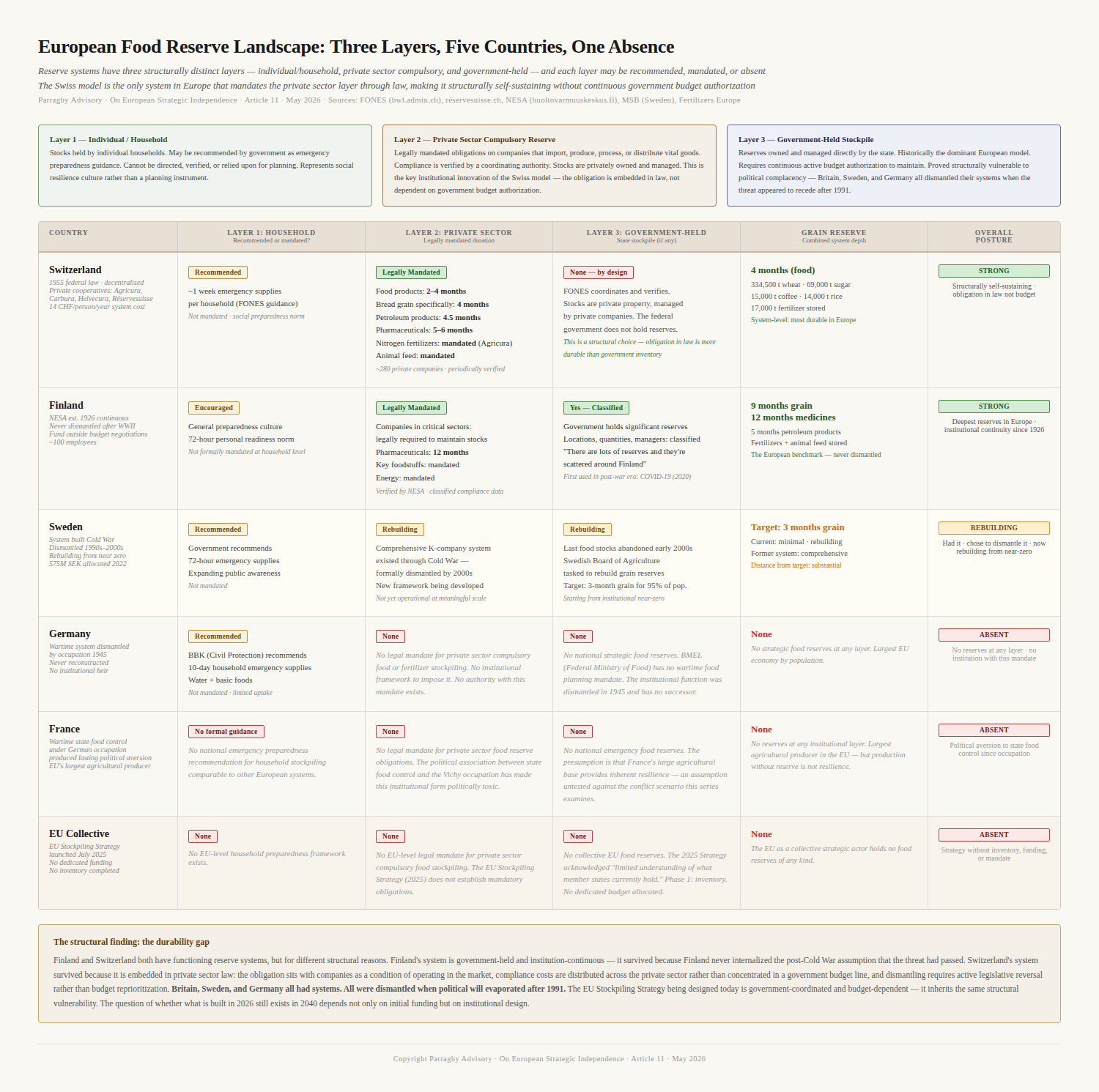
The Swiss federal government does not fund the reserves and does not hold them. It mandates them in law, and removing that mandate requires passing new legislation, which means it survives budget cycles, changes of government, and periods of perceived peace in a way that a budget line never can.
The structural lesson that follows from comparing these cases is that the institutional form of the reserve obligation determines whether it survives. A reserve held because a government chose to fund it this year is vulnerable to the government choosing differently next year, and a reserve held because a company is legally required to maintain it as a condition of its operating license is a different kind of commitment entirely.
The same logic that makes a statutory grain reserve more durable than a budget-funded one applies identically to fertilizer inputs. A grain reserve bridges the gap to the first conflict-affected harvest, and a fertilizer reserve ensures the second harvest is possible. Without pre-positioned fertilizer inputs maintained through the same kind of legal obligation that makes the Swiss system structurally durable, the grain reserve buys one growing season and no more.
Currently, no European member state and no European institution has a legal framework that mandates fertilizer input reserves at any level, and neither Germany, France nor other EU member states do hold strategic food reserves at any institutional layer. The EU Stockpiling Strategy launched in 2025 acknowledged that member states have limited understanding of what stocks currently exist, and Phase 1 of that strategy is an inventory exercise.
The EU as a collective strategic actor holds no food reserves of any kind, and no European institution currently mandates reserves of the raw materials and chemical compounds required to produce fertilizers at any level. That is where the supply chain analysis that follows begins.
The vulnerability of the nitrogen-based fertilizer supply chains
Part IX of this series established that preparing for the worst case and finding it does not arrive is always preferable to preparing for a more comfortable scenario and discovering the error at the moment it becomes irrecoverable. In August 2022, the worst-case scenario up to that point for European nitrogen fertilizer production arrived in peacetime from a gas price movement. While import alternatives were still partially available, this event still placed EU nitrogen fertilizer capacity in a zone that, under conflict conditions without those import alternatives, would have produced widespread nutritional shortfall within one growing season.
European natural gas prices peaked between €340–350 per megawatt-hour in August 2022. At that price, producing ammonia through steam methane reforming was uneconomical for the majority of European producers, and the cascade that followed was direct and mechanical.
Yara's Sluiskil facility in the Netherlands, the largest single ammonia and fertilizer complex in Western Europe with an annual capacity of approximately one million tonnes of ammonia, reduced output to approximately 55 percent of capacity. BASF's Ludwigshafen complex, the largest chemical production site in Europe, reduced ammonia output by 40 percent and cut methanol production substantially. Grupa Azoty in Poland, the country's primary ammonia and nitrogen fertilizer producer with approximately 1.5 million tonnes of annual ammonia capacity across its Tarnów, Police, and Kędzierzyn-Koźle sites, ran at approximately 10 percent of capacity at the August peak. Yara's Porsgrunn facility in Norway, and OCI's facilities at Amsterdam and Geleen in the Netherlands reduced output as well.
The EU's annual demand for ammonia for fertilizer production amounts to approximately 12.2 million tons. At the peak of natural gas prices in August 2022, active production had fallen to approximately 3.7 million tons per year in light of this demand, as approximately 70 percent of Europe's nitrogen fertilizer production capacity was idled.
The downstream consequences followed, with nitric acid production falling in proportion because it is produced at the same plants that produce ammonia, through the Ostwald process that converts ammonia to nitric acid. Ammonium nitrate and calcium ammonium nitrate production fell as well. European farmers reduced nitrogen application rates because fertilizer prices had surged to levels that made full-rate application uneconomical. The result was an 8 to 15 percent cereal shortfall in affected growing areas in the subsequent harvest, attributable entirely to reduced nitrogen availability. Fertilizers Europe estimated that European farmers paid approximately €60 billion more for fertilizers in 2022 compared to 2020 prices.
This event happened in peacetime, with market alternatives partially available, with no military pressure on logistics or infrastructure. The conflict scenario I examine in this series either removes or materially reduces all three of those buffers simultaneously.
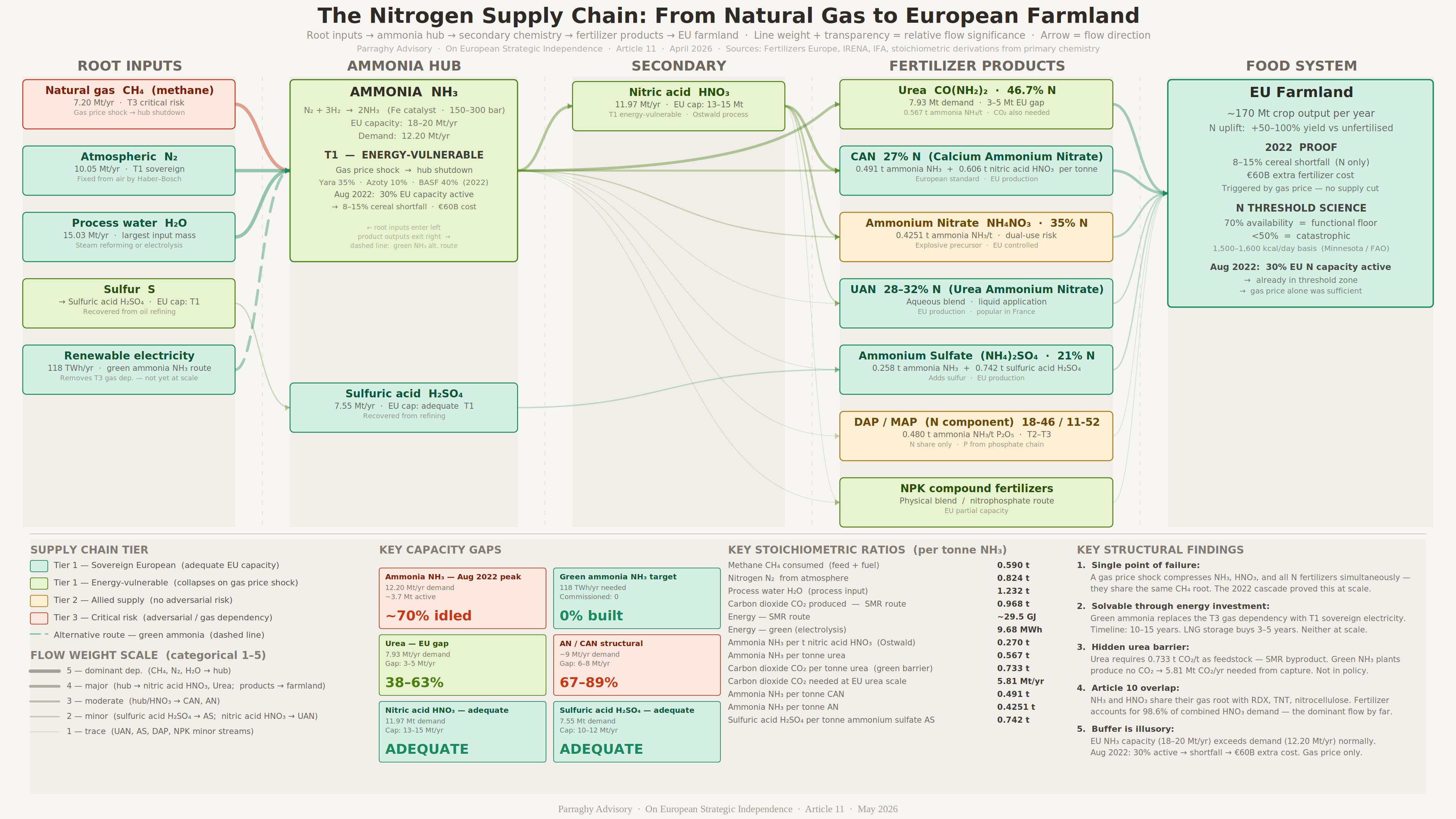
Natural gas feeds the steam methane reforming process that produces hydrogen. Hydrogen combines with atmospheric nitrogen in the Haber-Bosch synthesis to produce ammonia. Every nitrogen fertilizer that European agriculture uses, urea, calcium ammonium nitrate, ammonium nitrate, urea ammonium nitrate, ammonium sulfate, monoammonium phosphate (MAP) and diammonium phosphate (DAP) nitrogen components, and NPK compounds, traces to that single ammonia hub.
Ammonia is the molecule from which all nitrogen fertilizer chemistry derives, and every EU facility that makes any nitrogen fertilizer product draws on the same ammonia production capacity.
The nitric acid connection extends the vulnerability beyond fertilizers. The same ammonia that produces nitrogen fertilizer also produces, through the Ostwald process, the nitric acid that serves as an intermediate for ammonium nitrate fertilizer and for the RDX and TNT explosive chemistry documented in the previous article, Part X: European ammunition sovereignty and the supply chains it requires.
EU fertilizer production uses approximately 11.97 million tonnes of nitric acid per year, and EU ammunition chemistry uses approximately 0.17 million tonnes of nitric acid per year, which means that fertilizers make 98.6 percent of the combined nitric acid demand. An energy shock that compresses ammonia production compresses fertilizers and ammunition chemistry at the same time from the same root.
The annual European ammonia production capacity nominally exceeds demand, at 18 to 20 million tonnes against an annual demand of 12.20 million tonnes. The spike in natural gas prices in August 2022 demonstrated that the buffer between production capacity and demand is structurally illusory when gas prices rise, because producers shut down rather than produce at a loss. Under conflict conditions, where natural gas supply may be physically disrupted rather than merely price-elevated, the buffer provides no protection.
As of writing this article, and within the limits of my research, neither the European Union nor any of the member states holds strategic ammonia reserves. Storing ammonia requires, due to its chemical properties, which makes it a toxic, corrosive and hazardous substance, either refrigeration at minus 33 degrees Celsius or pressurized storage at ambient temperature, which means it cannot be stockpiled in ordinary agricultural infrastructure. LNG storage at European terminals provides a gas supply bridge of approximately three to five years if expanded at the rate currently planned, but current LNG terminal capacity covers only a fraction of what a full replacement of Russian pipeline supply would require.
The structural solution for European nitrogen production's dependence on natural gas is green ammonia, produced through electrolysis rather than steam methane reforming, eliminating the dependency on natural gas and replacing it with a sovereign electricity generation. The transition timeline at European scale, unless coordinated and accelerated, is 10 to 15 years. At 9.68 megawatt-hours of electricity per tonne of ammonia, producing the 12.20 million tonnes of ammonia the EU requires annually through green electrolysis would require approximately 118 terawatt-hours of electricity per year, approximately 10.5 percent of all EU renewable electricity generation at current levels, before accounting for any other electrification demand.
The transition to green ammonia requires addressing and resolving the dependence of urea production on carbon dioxide. The Haber-Bosch process powered by steam methane reforming produces carbon dioxide as a byproduct of the reforming reaction, which is captured by integrated SMR-urea plants and fed directly into the urea synthesis reactor, where it reacts with ammonia to produce urea. The reaction consumes 0.733 tonnes of carbon dioxide per tonne of urea.
Green ammonia plants powered by electrolysis produce no carbon dioxide, and a European ammonia system that transitions to green production while maintaining urea as a fertilizer product must source approximately 5.81 million tonnes of carbon dioxide per year from alternative sources, through industrial carbon capture or biogenic sources. None of these alternatives are at the scale required, none are costed into green ammonia transition plans, and none appear in any European fertilizer sovereignty policy document examined for the purpose of writing this article. The constraint itself is documented in the green ammonia technical and academic literature, and the engineers working on transition designs are aware of it.
The more significant finding is that a known technical constraint has not been translated into the policy documents that are supposed to be converting that technical knowledge into planning decisions. That is a more troubling gap than simple ignorance would be, and one that mid-program discovery will make far more expensive to correct than designing for it from the outset. The practical implication is that the green transition, if conducted without addressing the carbon dioxide supply, forces a product mix shift away from urea toward ammonium nitrate and calcium ammonium nitrate, which amplifies the dual-use overlap with ammunition chemistry.
The geological constraint of phosphate
No energy investment, no industrial program, and no policy initiative changes where phosphate rock deposits of economically viable grade exist. Morocco and Western Sahara together hold approximately 72 percent of identified global phosphate reserves.
The operative counterparty for the supply security and diplomatic analysis that follows is the Moroccan state through OCP Group, which administers mining and processing operations on both Moroccan sovereign territory and in Western Sahara. The legal status of Western Saharan reserves and the extent to which any EU-Morocco framework can cover production originating there is a question the European Court of Justice has previously engaged with in constraining EU trade agreements with Morocco on exactly this basis, and any government moving toward the supply relationship proposed here should obtain legal analysis of what that framework can and cannot cover before committing to supply volumes that depend on Western Saharan production. This article treats Morocco as the effective commercial and diplomatic counterparty without prejudging that question.
The EU's domestic reserve share is approximately 0.2 percent, concentrated entirely in the Siilinjärvi mine in Finland operated by Yara. The rock is not present in economically viable concentrations anywhere else in European territory.
The grade asymmetry makes the situation more constrained than the reserve share figure alone suggests. Moroccan ore grades run between 28 and 34 percent phosphorus pentoxide, requiring 3.47 tonnes of rock to produce one tonne of phosphorus pentoxide product. Siilinjärvi ore grades run between 3 and 5 percent, requiring approximately 24.7 tonnes of rock to produce the same tonne of product. That is a 7-fold difference in mining and processing intensity for an identical output.
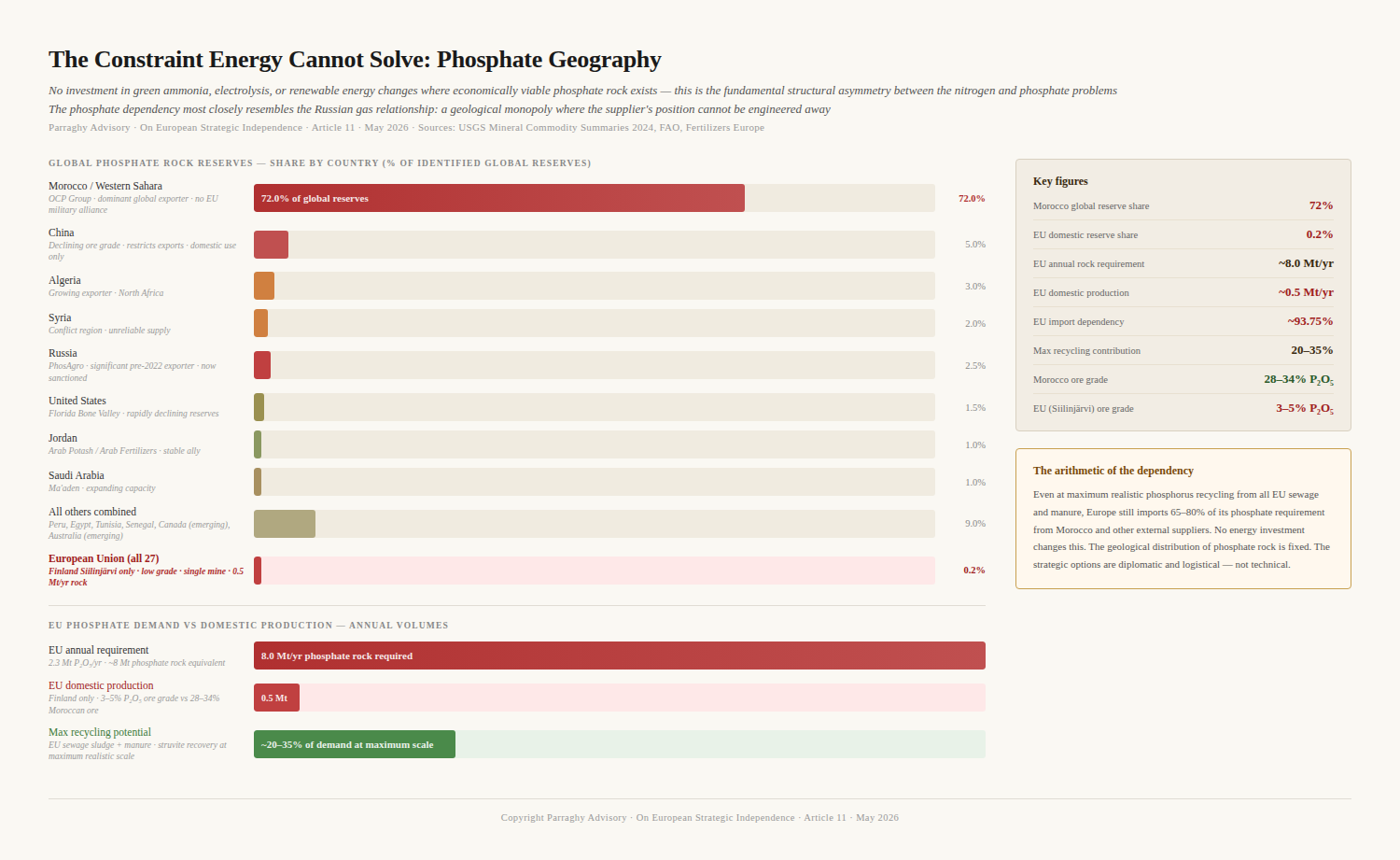
EU phosphate fertilizer demand requires approximately 7.99 million tonnes of phosphate rock annually. Siilinjärvi produces approximately 0.5 million tonnes per year, covering approximately 6 percent of demand. The remaining 7.5 million tonnes is imported, overwhelmingly from Morocco through the OCP Group, the Moroccan state-owned phosphate mining and processing company.
OCP operates a major phosphoric acid and fertilizer processing facility at Rotterdam in the Netherlands, one of the primary entry points for Moroccan phosphate rock into the European market. Prayon, headquartered in Engis near Liège in Belgium, is the primary European wet-process phosphoric acid producer, converting imported Moroccan rock through the sulfuric acid dissolution route. Both facilities are European in address and in processing capacity, but neither controls its upstream input. A disruption to Moroccan rock supply, whether from political decision, port closure, or shipping route interdiction, shuts down both facilities within weeks.
The dissolution process creates a byproduct burden that EU coastal processing infrastructure is not designed to manage sustainably at scale. The wet-process reaction between phosphate rock and sulfuric acid produces approximately 5.0 tonnes of phosphogypsum, a weakly radioactive calcium sulfate compound, for every tonne of phosphorus pentoxide processed. At EU demand scale, that is approximately 8.63 million tonnes of phosphogypsum per year. It is largely unrecyclable at commercial scale, and EU coastal processing facilities hold growing stockpiles with no commercially viable disposal route identified.
The sulfuric acid required for wet-process dissolution, approximately 4.49 million tonnes per year for the EU phosphate chain, is itself a supply chain dependency. European sulfuric acid production is largely a byproduct of metal smelting and oil refining, both of which are in structural decline in the EU under energy and climate policy pressure. A conflict that disrupts European refining capacity reduces sulfuric acid availability simultaneously with the other supply pressures the analysis documents.
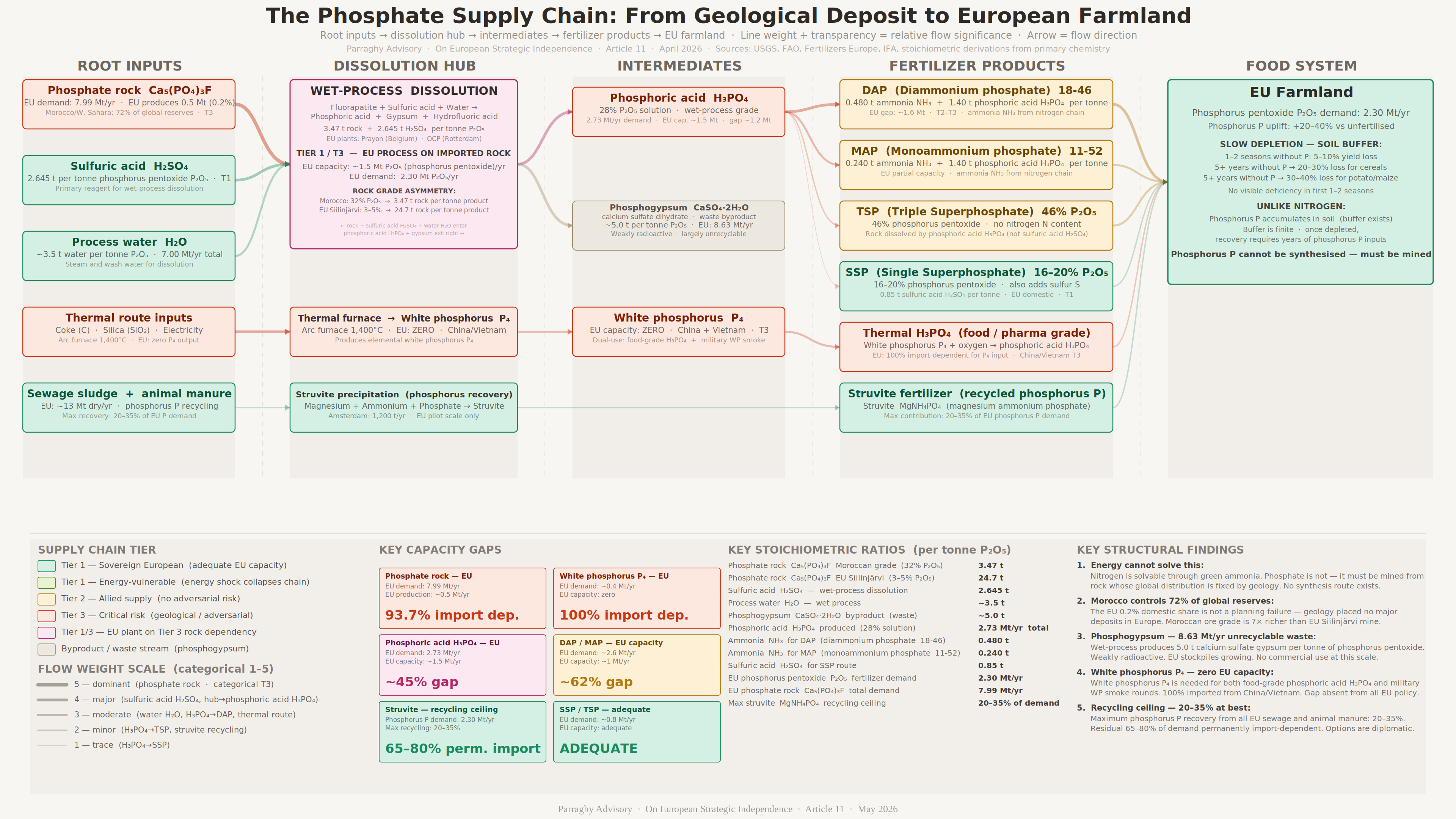
Food-grade and pharmaceutical-grade phosphoric acid requires the thermal route, which processes phosphate rock in electric arc furnaces at approximately 1,400 degrees Celsius to produce elemental white phosphorus. The European Union has zero production capacity on the thermal route, as white phosphorus is produced entirely in China and Vietnam. That is a 100 percent import dependency for an input required by food processing, pharmaceutical manufacturing, and, as Part X documented, military white phosphorus smoke rounds.
Maximum realistic phosphorus recovery from all EU sewage sludge and animal manure reaches approximately 20 to 35 percent of EU phosphorus demand at optimistic efficiency. The Amsterdam wastewater authority demonstrated in 2024 that struvite recovery from a city of 750,000 people produces approximately 1,200 tonnes of struvite fertilizer per year. The residual 65 to 80 percent of European phosphate demand is permanently import-dependent, and the strategic options are constrained.
Potassium and a seemingly simple solution
The EU imports approximately 76 percent of its potassium fertilizer requirement. Before 2022, that import dependency was distributed across several sources, with Russia and Belarus together supplying approximately 34 percent of EU potash demand, Canada supplying the majority of the remainder, and domestic European production and smaller allied sources covering the rest. In February 2022, Russia invaded Ukraine. The sanctions that followed removed both Russia and Belarus from the accessible supply base simultaneously.
The question that follows is whether European domestic production can be scaled to meet domestic demand, and if not, what the realistic alternatives are available.
European domestic production is the most politically straightforward alternative but the least analytically viable. Germany's K+S Group operates the only significant domestic EU potash source, producing approximately 2.4 million tonnes of potassium oxide equivalent per year from the Werra-Weser basin. K+S production is in structural decline for two compounding reasons. The accessible high-grade ore seams are progressively depleting, and the operation faces persistent environmental pressure from saline wastewater discharge into the Weser river system that has been the subject of ongoing regulatory conflict with downstream communities for decades.
No other European deposit of commercially viable grade exists, making the expansion of EU domestic production not a realistic pathway.
Jordan and Israel are alternatives. Both produce potash through solar brine evaporation from the Dead Sea, operated by Arab Potash in Jordan and ICL in Israel. Both are current commercial suppliers whose continued availability depends on regional political stability that Europe does not control, and neither can be treated as a guaranteed source under the conflict scenario this series examines. Combined Dead Sea production runs at approximately 3.3 million tonnes of potassium oxide equivalent per year, and both operations are already running at or near the physical ceiling that the Dead Sea's brine concentration and evaporation surface permit. The Dead Sea itself is shrinking, its water level falling by approximately one meter per year due to upstream water diversion from the Jordan River, which means the long-term production trajectory from this source is structurally declining rather than expandable. Jordan and Israel are reliable sources for what they currently produce and for as long as Dead Sea hydrology permits.
Other sources including Chilean solar evaporation operations in the Atacama Desert and emerging producers in other geographies exist but at volumes and with logistics profiles that do not constitute structural solutions at EU scale. None of them individually or collectively covers the gap that the simultaneous removal of Russian and Belarusian supply created.
That elimination process produces a single conclusion. Canada holds between 30 and 36 percent of identified global potash reserves, concentrated in Saskatchewan. Nutrien, a Canadian company, operates the Vanscoy, Allan, Cory, Patience Lake, Rocanville, Lanigan, and Esterhazy mines in Saskatchewan. The Mosaic Company, an American chemical company, operates the Esterhazy and Colonsay mines and the Belle Plaine solution mine. Canada exports the majority of its production through Canpotex, the joint export marketing company owned by Nutrien and Mosaic, via the ports of Vancouver and Portland. Canada is a NATO ally with no geopolitical motivation to interrupt supply to European NATO partners under any conflict scenario short of a disruption that would also interrupt Atlantic shipping itself. It prices potash at market rates and produces substantially more than its own agricultural sector consumes.
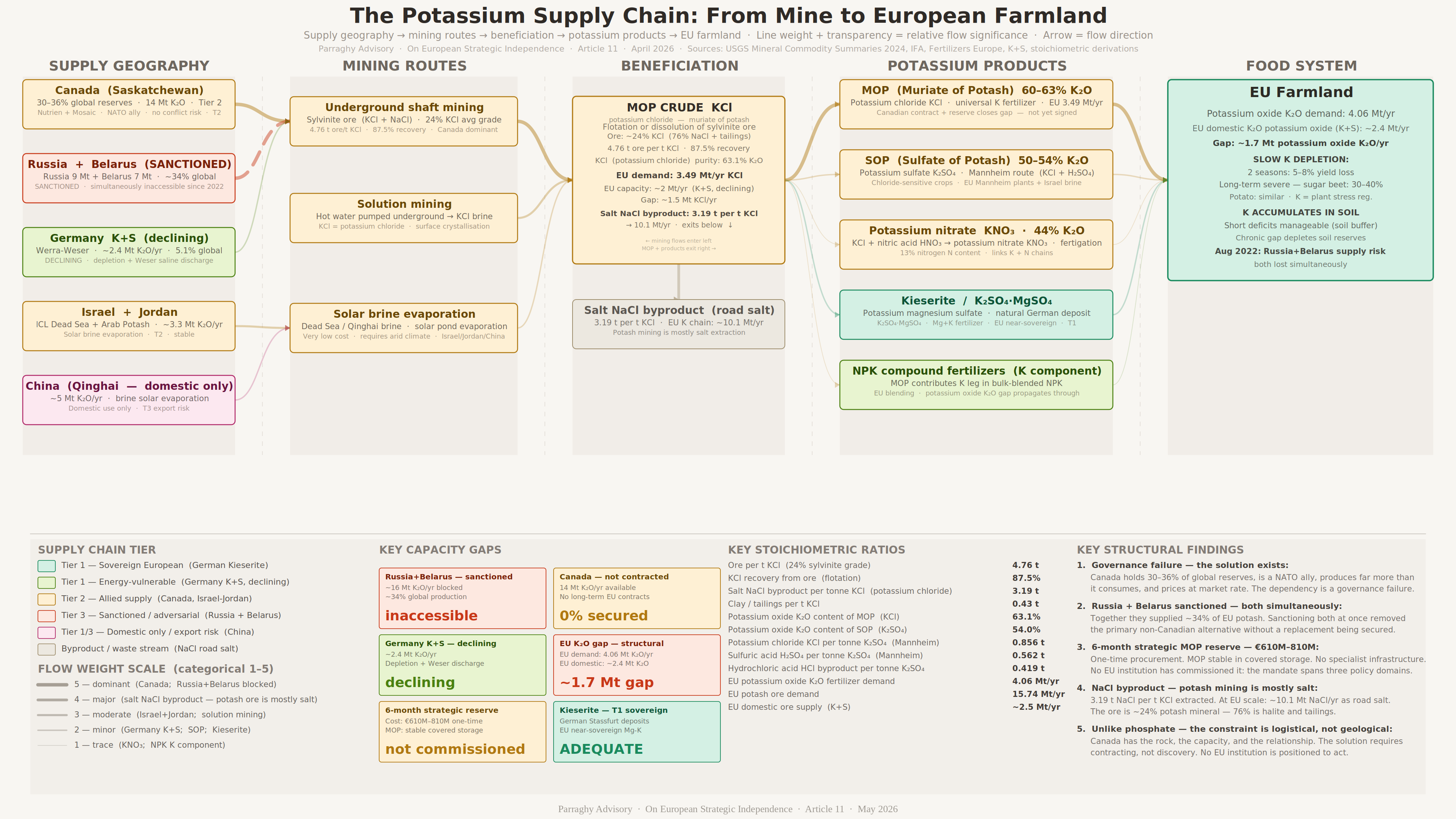
Securing the EU potash supply through Canadian production does not require new infrastructure, new technology, or exceptional cost. Muriate of potash, the standard commodity form of potassium fertilizer, is chemically stable at ambient temperatures. It absorbs moisture from the air if left uncovered, causing it to clump, but covered agricultural storage buildings of the kind that grain cooperatives and fertilizer distributors already operate across Europe are sufficient.
A six-month strategic reserve requires approximately 1.75 million tonnes of storage. At current market prices of approximately €350 to €450 per tonne, the one-time procurement cost is approximately €600 to €800 million. The logistics of moving that reserve from Canadian production to European storage are identical to the commercial logistics that already move Canadian potash to European agricultural markets every year through existing shipping routes and port facilities.
The decision to commission that reserve sits at the intersection of three EU policy domains that do not share a governance structure. Agricultural policy through the Common Agricultural Policy has no mandate for strategic input reserves because its design brief has never included conflict conditions. Industrial policy through the Critical Raw Materials Act does not classify potassium as a critical raw material despite its structural supply concentration in adversarial territory. Defense preparedness does not extend to fertilizer input reserves as a policy category. The potassium reserve decision requires someone to hold a mandate that spans all three domains simultaneously, and no EU institution currently does.
That institutional gap is the structural condition that determines whether any of the three gaps this article documents can actually be closed, and it is what the next section examines.
What European food sovereignty planning is not asking
The supply chain analysis above documents three structural dependencies, each with a different character and a different solution. Before asking what closing those gaps would require, it is worth asking why they have remained open. The answer is not that the dependencies are unknown. They are documented in industry publications, in academic research, and in the trade statistics of every European fertilizer importer. The answer is that the planning frameworks responsible for European food security were not designed to ask the question this analysis asks.
The EU's Common Agricultural Policy has managed European food production for more than six decades. Its design brief has been overproduction management, market price stability, rural development, and more recently environmental sustainability. It has never been asked to model what a sustained conflict would do to the supply chains that European crop yields depend on. The concept that a gas price movement in peacetime can produce an 8 to 15 percent cereal shortfall, and that under conflict conditions the same mechanism produces nutritional shortfall across the civilian population and the armed forces simultaneously, does not appear in any Common Agricultural Policy design document, because the Common Agricultural Policy was not designed to look for it.
The EU Strategic Reserves framework addresses grain stocks, medical countermeasures, and selected industrial inputs. It does not address the inputs required to produce the next harvest. A six-month grain reserve that is not accompanied by reserves of the raw materials and chemical compounds required to produce fertilizers is a bridge that ends before it reaches the other side. The framework has not made this connection because grain reserves and fertilizer input reserves sit in different institutional domains with different responsible authorities, and neither authority has been asked to consider the dependency that links them.
The Critical Raw Materials Act of 2024 identifies 34 critical raw materials and 17 strategic raw materials requiring specific domestic capacity targets and supply diversification obligations. Phosphate rock does not appear on either list. Potassium does not appear on either list. Both have structural supply dependencies in adversarial or conditionally reliable geographies. Both are inputs to the food production system the conflict scenario this series examines depends on. Their absence is not a technical oversight. It is the output of a legislative process whose planning standard did not include the question this series has been asking since Article 8.
The institutional design that makes a reserve system structurally durable, one where the obligation is embedded in statute rather than funded through a budget line, already exists in Europe. It has simply never been applied to the raw materials and chemical compounds that European fertilizer production depends on.
What closing the gaps would require
The supply chain analysis produces three conclusions, each with a different character. Nitrogen is an energy problem with a known technical solution on a long timeline. Phosphate is a geological problem with no industrial solution and a diplomatic one that depends on negotiation rather than investment. Potassium is a governance problem with a solution that is technically available today and has been available since the day Russia and Belarus were simultaneously sanctioned without a replacement supply arrangement in place.
A reader who has followed the analysis to this point might reasonably conclude that the sequence should start with potassium, since it is the cheapest, the most immediately actionable, and the most straightforwardly solvable. That conclusion is correct in theory and blocked in practice, and understanding why it is blocked leads directly to the structural problem that determines whether any of the three gaps can actually be closed.
Why the governance question comes first
The potassium reserve decision requires commissioning a procurement contract with Canpotex, acquiring approximately 1.75 million tonnes of muriate of potash, placing it in covered agricultural storage across European territory, mandating that it be maintained through a legal obligation rather than a budget line, and governing the entire operation under a security classification framework that protects the locations and volumes from adversarial knowledge. Each of those steps requires an institutional authority that holds a mandate spanning agricultural policy, industrial policy, and defense preparedness simultaneously. No EU institution currently holds that mandate. The agricultural policy authority does not cover defense preparedness. The defense preparedness framework does not extend to fertilizer input reserves. The industrial policy framework does not classify potassium as a strategic material requiring reserve obligations.
This is not a gap that persisted because the solution was unknown or unaffordable. It persisted because the decision sits in the institutional space between three policy domains that do not share a governance structure, and no actor has been given the authority to operate across all three simultaneously.
The same governance gap blocks the nitrogen and phosphate responses. The LNG bridge for nitrogen requires a decision about strategic gas storage that touches energy policy, defense preparedness, and industrial strategy simultaneously. The green ammonia transition requires coordinating energy investment, fertilizer industry restructuring, and carbon capture infrastructure under a single planning framework. The phosphate reserve and diplomatic track requires someone with the authority to commit to long-term supply agreements with Morocco, maintain physical rock stockpiles under security classification, and mandate private sector participation in reserve holding.
None of these decisions can be made correctly without first resolving the governance question. A potassium reserve commissioned without a security classification framework is a publicly known target. A green ammonia program launched without the carbon dioxide constraint addressed is a program that will require expensive and disruptive mid-course correction. A phosphate reserve procured without a mandate durable enough to survive the next election cycle will follow the same trajectory as every budget-dependent European reserve system after 1991.
The governance mandate is therefore not the last thing to address. It is the first, because without it every subsequent decision is either blocked, incomplete, or structurally vulnerable to the same political cycle that has already dismantled every prior reserve system Europe built.
What the governance mandate must cover
The institutional mandate required has three components, and all three must be present simultaneously for the mandate to be effective.
The first is cross-domain authority. The institution must hold a legal mandate that spans agricultural policy, industrial policy, and defense preparedness without requiring coordination across separate authorities for every decision. The Swiss FONES model provides a template at the national level. A European equivalent would require either a new institutional structure or a formal expansion of an existing institution's mandate through treaty or primary legislation, not through interagency coordination agreements that can be dissolved as easily as they are formed.
The second is a statutory reserve obligation rather than a budget-funded program. Every reserve system that survived the post-1991 dismantling survived because the obligation was embedded in law rather than dependent on annual budget authorization. The fertilizer input reserve mandate must follow the same design. Companies that import, process, or distribute the raw materials required to produce fertilizers in European territory must be legally required to maintain reserves as a condition of operating, with compliance verified by the responsible authority and rotation costs distributed across the commercial operations that benefit from the market access the legal framework provides.
The third is security classification. The locations of reserve holdings, the volumes held at individual sites, and the operational details of the reserve system must be classified under the same framework that governs ammunition pre-positioning, pharmaceutical precursor stockpiles, and other strategic material reserves. A reserve whose location is publicly known is not a strategic reserve. It is a target. In the opening phase of a conflict, an adversary with knowledge of reserve locations can eliminate the buffer the reserve was designed to provide before it is drawn on. The operational value of a reserve depends entirely on its survivability, and its survivability depends on the adversary not knowing where to strike. This is not a theoretical concern. Military doctrine across every serious strategic actor classifies strategic stockpile locations as sensitive information for precisely this reason. European fertilizer input reserves must be governed under the same principle.
The second group of individuals with medically prescribed dietary needs
As stated in the planning standard, I'm returning to the second group of individuals with medical conditions that require a specific diet. A registry of individuals with medically prescribed dietary needs does not exist anywhere in Europe, and establishing it raises questions the supply chain analysis now makes possible to answer precisely.
Such a registry must contain identity, location, diagnosis, and what each individual requires against what the supply chains examined in this article can actually deliver under conflict conditions. An individual managing type 1 diabetes either through a controlled carbohydrate-based or a ketogenic diet has different supply chain implications from an individual with phenylketonuria requiring protein substitutes, which has different implications again from a severe anaphylactic allergy to a staple crop.
The registry becomes an operational planning instrument that tells the rationing authority which inputs must be secured at what volumes to serve the registered population.
Establishing such a registry of individuals with medically prescribed dietary needs constitutes a database of sensitive health information that is subject to the General Data Protection Regulation (GDPR), which raises legal questions. To be functional for conflict rationing purposes it would need to be accessible across member state boundaries, linked to supply chain data, and operationally accessible and available to distribution authorities under conditions where normal administrative infrastructure may be degraded.
The legal basis for storing, holding, accessing and using that data in that form does not currently exist under GDPR, and establishing it would require either primary EU legislation or a member state coordination framework that has not been proposed. The governance of the registry is therefore not only a question of who holds the mandate, but of what legal basis permits the data to be held at all in the form that conflict rationing would require.
The logistics question compounds this. Individual delivery to dispersed addresses across the territory of a country under conflict conditions, with damaged infrastructure and contested logistics routes, is operationally far more demanding than provision to concentrated locations. The demand on delivery capacity grows with every kilometer of separation between supply hub and recipient address, and conflict conditions systematically degrade the transport infrastructure that individual delivery depends on.
The simplest operational solution would be mandatory co-location, requiring individuals with medically necessary dietary needs to relocate to designated care and supply points where the government can guarantee provision without the logistics burden of dispersed delivery. The case for it is that the concentrated supply is operationally feasible where dispersed supply under conflict conditions may not be.
The case against mandatory co-location is that compelling individuals to leave their homes and communities because of a medical condition is a significant infringement on individual freedom, which would certainly lead to resistance. A democratic government that mandates co-location for this group must justify why the operational convenience of the distribution system outweighs the rights and welfare of the individuals being compelled to relocate. That justification is difficult to make cleanly, and the political and legal resistance it would generate in any democratic society would consume institutional energy that could be directed at the actual supply chain problem.
Voluntary co-location threads that needle. A democratic government committed to planning for the worst case can make co-location available as a genuinely supported option with designated facilities, guaranteed supply appropriate to each individual's medical requirements, and the medical support those requirements demand. The choice then falls to the individual. Those who choose to co-locate receive guaranteed provision.
Those who choose not to co-locate accept that outside the co-location system, the government's obligation to ensure supply cannot extend to individual delivery under conflict conditions. Supply may not reach a dispersed address reliably, and in some periods may not reach it at all. That is the operational reality of a conflict rationing system that cannot simultaneously guarantee dispersed individual delivery and concentrate resources where they can be maintained.
Those individuals who remain outside the system accept that risk as their own. A democratic government that communicates this limitation when a conflict arises has fulfilled a form of moral obligation, even if it cannot fulfill the logistical one. Promising universal provision, even though one knows that operational conditions make this impossible, is unethical and immoral. What this framework asks of the government under those circumstances is honesty about what the system can and cannot guarantee, and organizational commitment to making the co-location option genuinely workable for those who choose it.
What makes this genuinely voluntary rather than merely formal is the right to reconsider at any point. A person who initially believes they can manage independently and finds that supply is not reaching them should be able to co-locate later, without penalty and without having forfeited their place in the system. Equally, someone who co-locates and later chooses to leave should be able to do so, accepting the same risk as anyone else outside the system. The system must be designed for movement in both directions, because the conditions of a conflict change, people's understanding of those conditions changes, and a choice that was reasonable at the outset may need to be revised as the situation develops.
None of the institutional prerequisites for any of this exist.
The three timelines
Once the governance mandate exists, the preparation required across the three nutrient chains can be sequenced honestly.
The potassium reserve is procurable within months of the mandate being established. The procurement contract, the storage allocation, and the legal reserve obligation can all be put in place within a single planning cycle if the institutional authority exists to commission them. This is the fastest gap to close once the governance prerequisite is met.
The LNG bridge for nitrogen requires three to five years to expand European terminal capacity to the level required for a full replacement of Russian pipeline supply. That expansion is partially underway but not at the required rate. The bridge buys time for the green ammonia transition, which is the long-horizon investment.
The green ammonia transition is structured as a 10 to 15 year program, and that timeline was established under peacetime planning assumptions. Parts IV through VII in this series examined the conditions under which a conflict with Russia could materialize, and the conclusion those articles reached is relevant, as Russia does not need to have reconstituted full conventional military power to initiate conflict, and the timeline Europe is working with is shorter than the planning horizon most current policy is designed around.
A 10 to 15 year transition timeline for European nitrogen sovereignty is not adequate preparation for a conflict window that the defense cluster analysis placed within the current decade. The transition needs to be coordinated and accelerated to compress that timeline to the shortest technically feasible duration, which is a different design brief from the one currently driving European energy and industrial policy. That structural argument, and what it would take to act on it across all three chemistry clusters simultaneously, is what I will examine following the articles covering technology cluster. What this article can state plainly is that the carbon dioxide constraint for urea production must be addressed in the initial planning documents for the transition rather than discovered after the first plants are commissioned, because mid-program redesign on a compressed timeline is far more expensive and far more disruptive than designing it correctly from the outset.
The phosphate track runs in parallel with all of the above and cannot be accelerated by investment. The timeline is determined by diplomacy and negotiation because the constraint is geological. What can be done immediately under the reserve mandate is procuring a stockpile of phosphate rock and processed intermediates, classifying its locations, and beginning the diplomatic engagement that a durable long-term supply relationship requires.
What Europe can offer Morocco is a sectoral framework in which phosphate mining operations adopting EU-equivalent standards in labor rights, occupational safety, and environmental protection gain preferential access to EU markets, EU development financing, and EU technical assistance. Morocco gains something it wants for its own development reasons, while Europe gains supply security embedded in a relationship with structural depth across multiple dimensions, which is more durable than a commercial contract that either party can exit when circumstances change.
What no diplomatic or commercial framework can change is the geological reality. The honest planning baseline accepts that 65 to 80 percent of European phosphate demand will remain import-dependent indefinitely. The preparation required is managing that dependency under the most durable and mutually beneficial terms available.
What Article 12 will examine
In the articles Part IX to XI, I have mapped the supply chains that pharmaceutical sovereignty, ammunition production, and food security each depend on. What I have not yet examined is what the suggested changes and combined investment figure implies for European strategic planning.
In Part XII I will examine the economic, social, and geopolitical dimensions that the supply chain analysis opens but cannot close on its own, including what a durable European relationship with Morocco over phosphate supply would require in practice, and how China is likely to respond to a sustained European effort to reduce dependency on Chinese chemical exports across all three clusters, because China will not surrender the leverage it created over decades without a response.