This is part A of the twelfth article in a series where I examine the structural conditions that would need to change for Europe to function as a genuinely independent strategic actor.
In the previous article I established that the three fertilizer supply chains European agricultural production depends on are structurally different problems requiring structurally different responses.
In this article I read Parts IX through XI as one argument, establish what that argument reveals about the system those three supply chains share, and examine whether the frameworks European policy has built to govern the dependencies that system contains are the right response to what it is.
In articles 4 through 7 I established that European forces require a fundamental redesign. The geography of a 2,500 kilometer shared border with Russia, and the character of the warfare that three years of conflict in Ukraine have made visible, demand forces capable of detecting and responding to pressure within hours at any point along that frontier.
A NATO exercise on the Swedish island of Gotland in May 2026 illustrated that gap directly. Ukrainian drone pilots invited to teach Western forces how to win at drone warfare played the aggressor role and destroyed Sweden's troops in the exercise. The exercise had to be paused three times for commanders to work out what to do better, and one of the Ukrainian pilots noted that if it had been a real engagement, the Swedish forces would have been dead.
That capability does not currently exist, and building it requires reconstructing not just equipment inventories but the doctrinal procedures and the logistical backbone through which forces would operate. That includes the airlift capacity, the helicopters, the fighter coverage, and the ground crews and logistics personnel through which equipment and supplies can be packaged and moved into an engagement zone under time pressure.
My analysis of those three supply chains rested on an implicit assumption. I had to validate whether Europe has the industrial capacity on sovereign territory to produce the chemical compounds and raw inputs that pharmaceutical, ammunition, and fertilizer production all depend on at their base, and whether that capacity exists at the scale the scenario would require, or whether it would depend on suppliers who could restrict access, apply pressure, or use that dependency to extract terms Europeans would not otherwise accept.
I established that the three supply chains draw from one bulk chemical industrial system, meaning the same upstream compounds and production infrastructure supply pharmaceutical manufacturers, ammunition producers, and fertilizer supply chains as separate customers of the same base.
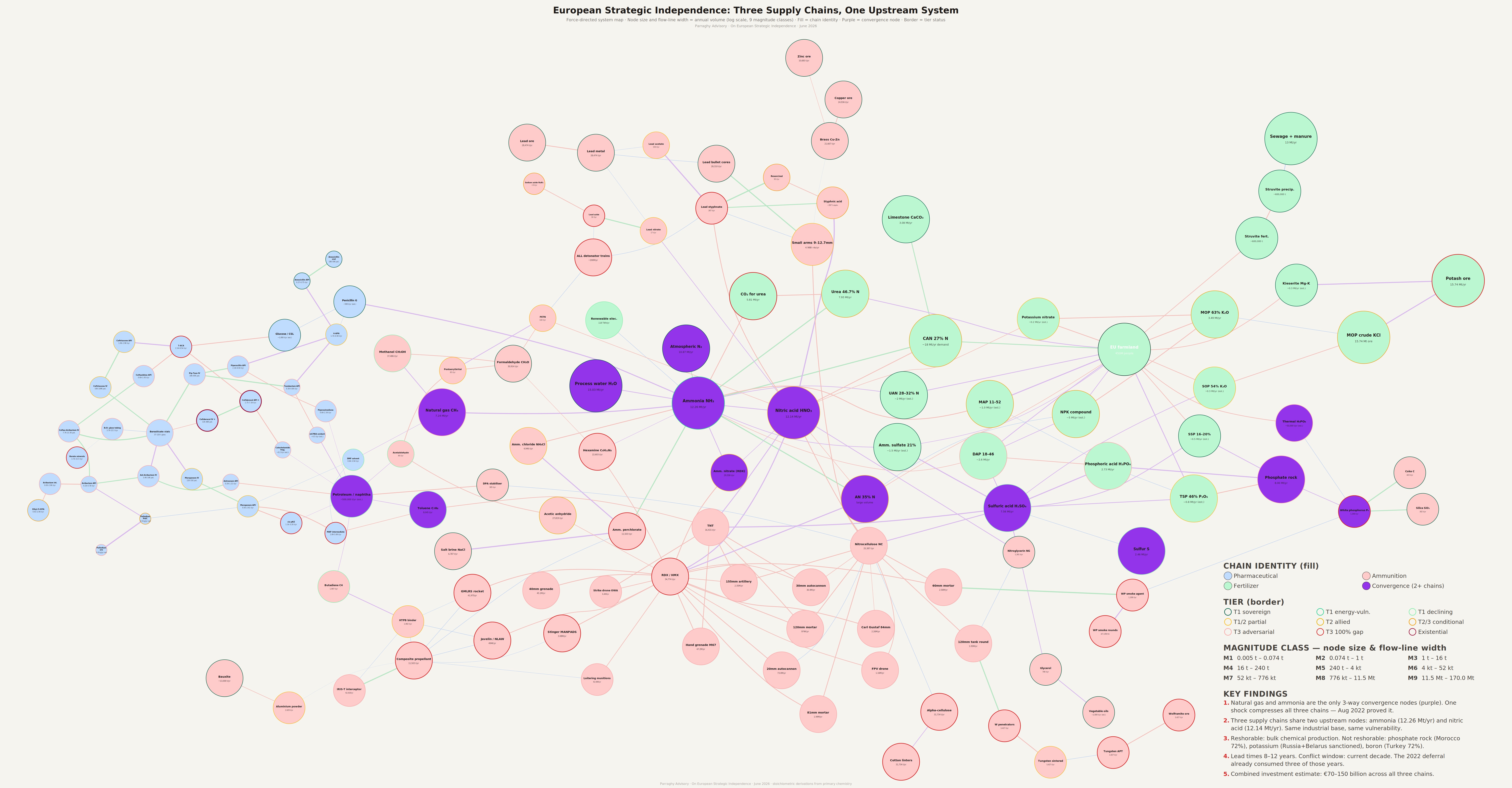
What the bulk chemical industrial system requires to be reconstructed and governed
The first question the supply chain analysis opens is how the response to its findings should be organized, and the most natural answer is the one European policy has already been working toward. Three separate programs, each owned by the institution closest to its domain, each drawing on existing expertise, existing rules for how governments buy things, and existing relationships with the industries it governs. A pharmaceutical sovereignty program run by health and industry authorities. This is internally coherent, and each authority can start the program without waiting for the others, and each addresses a real and documented vulnerability.
The question is whether three programs addressing three expressions of one system produce the same outcome as one program governing the system as a whole.
Let's consider what three programs based on the same upstream base would achieve in practice. Each program commissions new ammonia production capacity, negotiates long-term natural gas supply contracts to secure its chemical processes, and selects sites for its plants based on a set of variables that makes the respective location profitable for its own sector. In the initial phase, during which each program operates within the scope of its available resources, real progress is made as plants come online and production capacity grows, and each sector moves toward its goal independently of the others.
When the available room for isolated improvement runs out, the programs are no longer operating independently. They are competing for the same engineering firms, the same grid connections, the same upstream feedstock supply, and the same specialist labor pool. At that point, progress in one domain comes at the expense of what is available to the others. And when an upstream shock compresses the shared resource, as the 2022 energy crisis compressed European ammonia production, no individual program has the authority or the visibility to decide how the available supply should be allocated across all three downstream industries. Each responds to protect its own domain. The result is what I documented in Part VIII, a simultaneous compression across all three chains because the interactions between the programs were never aligned to optimize the performance of the system as a whole.
The bulk chemical industrial base and the industries and sectors downstream of it is that kind of system. Ammonia production capacity, energy infrastructure, engineering and construction labor, feedstock flows, and facility siting are not independent variables that three separate programs can each optimize without affecting the others. The interactions in a complex system like this are the structural condition of the system, and they determine whether the investment produces a coherent industrial base or three overlapping programs that each fall short of their targets.
The energy shock in summer of 2022 demonstrated at European scale that when gas prices rose to the point where ammonia production became uneconomic, the production cuts propagated simultaneously across fertilizer manufacturing, explosive chemistry, and pharmaceutical intermediate production, because all three depended on the same upstream molecule. No individual program governing its own domain had a mechanism to decide, at the level of the whole system, how the available production capacity should be allocated across the three downstream applications.
That points toward a single cross-domain mandate, meaning one governing authority with the power to make decisions across all three domains simultaneously.
Whether this can be solved at national level
The simplest version of a cross-domain mandate would be a national one. A sufficiently determined member state with the right industrial base could, in principle, task a single national authority with governing pharmaceutical, ammunition, and fertilizer chemistry investment simultaneously. Germany has the largest chemical industrial base in Europe, France has energy capacity that could support large-scale chemical production, and Poland has the political incentive that proximity to the eastern frontier creates. Could any one of them, or a bilateral agreement between two of them, build what the analysis requires?
The capital constraint is the first obstacle. The investment needed to build sovereign upstream chemistry at the volumes a conflict scenario demands across all three supply chains simultaneously runs into the tens of billions of euros for each domain separately. No single European member state can finance a program of that combined scale from its own resources without redirecting most of the rest of its defense and infrastructure investment.
Even if the capital constraints could be overcome through borrowing or coalition funding, a national program would still run up against the transparency requirements that public investment imposes on such programs in every European democracy. Ultimately, building permits, environmental assessments, procurement announcements, and parliamentary budget documents detail what is being built, where, on what scale, and why. Taken together, these form a map of a national program that reveals where the country's chemical production capacities are concentrated, which facilities are critical to the supply chain, and what the system depends on to function.
That map would be available to any actor who wants it without any intelligence capability beyond the ability to read public documentation. An adversary planning how to pressure a country, or under conflict conditions how to degrade its production capacity, does not need to discover that information through espionage if parliamentary transparency has already assembled it.
Now consider a bilateral program between two member states, each documenting its own share of the investment through its own national transparency framework. The result is two national maps that together describe a cross-border network, still publicly assembled, still readable by any interested party, but now also lacking the unified operational authority to coordinate the two halves into a coherent system under pressure.
The national-level response therefore fails on two grounds simultaneously. It cannot be financed at the required scale from national resources alone, and it cannot protect the operational details of what it builds from the transparency requirements that democratic public investment attaches to programs of this size.
What governing the system requires
Once we accept that the mandate must be European in scale, the next question is what that mandate must be capable of doing. The most constrained version of a European mandate is one that authorizes investment across the three domains, sets production targets, and leaves the design of the resulting infrastructure to the engineering and procurement processes that follow. That approach has the advantage of being the fastest to establish, because it does not require the governing authority to make decisions that are technically complex and politically sensitive before the investment begins. It commissions the outcome and allows the design to emerge.
The question is whether that version of the mandate produces a coherent system or three investment programs that happen to share a budget line.
The first design decision that any program of this scale must make is how production capacity should be distributed across Europe. The argument for concentrating production in a small number of locations is real. Existing industrial infrastructure, available engineering expertise, grid capacity, and proximity to logistics networks are not evenly distributed across the continent. Building where the conditions are already favorable is faster and cheaper than building where they are not. If the goal is operational capacity within the conflict window the defense cluster established, concentration gets you there sooner than distribution.
The constraint is what concentration means for the system's resilience. A network whose production capacity is concentrated in a small number of locations can be degraded by a small number of successful strikes, sustained cyberattacks on industrial control systems, or localized energy disruptions. Whether that risk is acceptable depends on how likely those events are under the conflict scenario the series has been examining, and the defense cluster's answer to that question is that the scenario in which European chemical production is under the most pressure is precisely the scenario in which the frontier is under simultaneous distributed attack. Concentrating production for the sake of efficiency and speed produces a system optimized for conditions that the conflict scenario makes unlikely to hold.
That points toward distributing production capacity across multiple sites, sized so that losing any one location leaves the system operational. But accepting that answer immediately raises a second question that the first option does not, which is what determines where the distributed sites are placed and what surrounds them.
Why location is not a secondary question
Once the case for distributing production across multiple sites is accepted, the next question is what determines where those sites are placed and what surrounds them. The instinctive answer, and the one that most industrial policy has followed, is to select sites based on whatever combination of available land, grid connection, transport infrastructure, and local government willingness makes each location viable at the time of investment. Each site is evaluated on its own merits. The result is a network of facilities distributed across the continent, each functional, each meeting its production targets, and each essentially isolated from the others in terms of the deeper conditions that determine whether an industrial base generates innovation and capability over time or simply produces output until the next disruption makes it obsolete.
The case for that approach is not trivial. It is faster to execute because it does not require coordinating site selection across multiple domains simultaneously. Further, it is cheaper in the near term because it draws on existing infrastructure rather than building it, and it produces operational capacity on a timeline the conflict window requires. If the goal is simply to have facilities producing the required compounds within the decade, optimizing each site independently gets you there.
The constraint emerges when you ask what that network looks like at year twenty rather than year ten. Industrial capacity that does not generate its own talent pipeline depends permanently on recruitment from elsewhere, which means it is perpetually vulnerable to labor market conditions it does not control. Capacity that does not develop its own supplier relationships and technical knowledge base cannot improve faster than the rate at which it can absorb knowledge from outside itself. And capacity that exists in geographic isolation from complementary activity does not benefit from the mechanism that drives industrial innovation over time, which is the natural movement of knowledge between organizations through the movement of people, informal relationships, and proximity.
Researchers studying industrial clusters call this knowledge spillover, and it is the reason why some geographic concentrations of industrial activity become self-reinforcing over decades while others remain static. The knowledge produced within a dense, diverse cluster distributes to surrounding firms without being deliberately transferred, because the conditions of density and proximity make that distribution the path of least resistance.
The distinction that matters here is between what the research literature calls an industry cluster and an innovation cluster. An industry cluster is a geographic concentration of similar facilities and firms that generates incremental improvement within a known field. It creates competitive advantage in what already exists. An innovation cluster is different. It is a dense, diverse network of complementary actors, facilities, universities, research institutions, suppliers, and firms from adjacent sectors, that creates the conditions for self-reinforcing density over time. The diversity is not incidental. More varied business models, expertise, and technical approaches become available across the co-located activities, and the interactions between them generate the kind of breakthrough capability that an industry cluster, however well designed, cannot produce on its own.
The Basel area illustrates what the second approach produces. The concentration of pharma, biotech, medtech, healthtech, advanced manufacturing companies, and other adjacent activity in that region emerged because enough complementary activity was concentrated in the same geography to create conditions that became self-reinforcing. This ranges from specialist labor that was trained at local universities and stayed because the opportunities were there, supplier relationships between neighboring firms that reduced costs and accelerated development, knowledge that moved between organizations through the normal movement of people, and a critical mass of activity that made the region attractive to each new entrant in ways that an isolated location could not replicate.
The warning that belongs here is the one industrial policy has historically ignored. Top-down approaches to building industrial clusters tend to commission the visible elements, a major facility, proximity to a university, investment incentives, without designing for the underlying conditions that make clusters self-reinforcing. There is little evidence that this formulaic approach produces the sustained innovation capacity it promises, because it mistakes the visible configuration of a successful cluster for the conditions that produced it.
The mandate governing European bulk chemical industrial investment should not make the same mistake. It should be capable of designing for the conditions that produce self-reinforcing density, not just the facilities that produce the required compounds in the near term, and it must make those design decisions before investment is committed, because retrofitting the conditions of an innovation cluster onto a network of already-built isolated facilities is considerably slower and more expensive than building them in from the outset.
What distributed production requires to remain strategically effective
A network distributed across deliberately designed hubs is harder to degrade than one concentrated in a small number of locations. But distribution only provides that protection under a specific condition, which is that an adversary does not know the network's architecture well enough to sequence their targeting efficiently. The question the investment planning cannot treat as secondary is whether the governance frameworks that any European public investment program requires are compatible with that condition.
The starting position for any public investment program in a democracy is transparency. Parliamentary oversight of public expenditure is the political precondition that makes large-scale programs survivable legally and across electoral cycles. A government that commissions tens of billions of euros of industrial infrastructure without parliamentary visibility creates the conditions for the program to be delayed, contested, reduced, or cancelled. The transparency frameworks that democratic public investment requires are therefore part of what makes the program possible.
The question is what those frameworks produce in operational terms, and whether what they produce is compatible with the strategic purpose of the investment.
Each of the documents required under parliamentary oversight for a public investment is individually unremarkable, but taken together they assemble a map of where production capacity is located, which facilities are critical to the overall system, what each site produces, and how the sites relate to each other. That map is available to any actor capable of reading public documentation. Under conflict conditions, it tells an adversary which facilities to strike, in what sequence, to degrade the network most efficiently. The distribution that was supposed to provide resilience only provides resilience against an adversary who does not know the network's architecture, and the standard transparency requirement removes that condition.
The question then is whether there is a version of democratic oversight that meets the accountability obligation without sharing the operational details. And there is. European democracies already operate it for infrastructure of this kind. A parliament that authorizes a defense or national intelligence budget approves expenditure within program envelopes at an appropriate level of abstraction. The accountability obligation is met through budget authorization, while the operational detail is held by military or intelligence personnel with the appropriate security clearances, subject to oversight mechanisms calibrated to the sensitivity of the material rather than to the transparency norms of civilian procurement.
The bulk chemical industrial base is not legally military infrastructure, and we need to ask whether that legal category is the right one to reason from, or whether the operationally relevant question is different.
What the conflict scenario the defense cluster spanning Part VI to VII established requires is that European forces and the society behind them can sustain themselves under pressure. Whether they can depends directly on whether the chemical production capacity that pharmaceutical, ammunition, and food supply chains draw from remains intact and functional under the conditions that pressure creates.
Consider what would happen if the location, capacity, and critical dependencies of a facility that manufactures pharmaceutical intermediates were publicly documented? We must assume that a potential adversary will eventually come across this information. Attacking such a facility in the early stages of a conflict would have significant consequences for field medicine and impact the care of the wounded, thereby affecting the morale and combat readiness of the troops. And this may seem inhumane to those without a armed forces or defense background, but it is part of the nature of conflict to push the enemy toward surrender in one way or another. Wearing down the will to resist, among civilians and troops alike, is one of the means of achieving this. This is one of the reasons why civilian facilities and critical infrastructure, such as energy, food, and healthcare supplies, often become military targets, especially by authoritarian regimes.
This led me to conclude that the bulk chemical industrial base should not be subject to parliamentary oversight under its transparency frameworks, and should instead be treated as critical military infrastructure subject to the respective military classification frameworks.
Whether any existing European institution can hold this mandate
Once the full scope of the mandate is clear, the question of who holds it becomes specific. The mandate requires the authority to commission investment across all three domains simultaneously, across member state borders, and the ability to hold the operational details of what it builds under classification frameworks appropriate to critical military infrastructure.
It is worth asking whether any existing European institution could hold that mandate if its scope were extended or its design modified, because creating a new institution from nothing requires a political process that the conflict window may not accommodate, and if an existing institution can be adapted, that is a faster path.
The European Defense Agency has the closest mandate to what the program requires. It operates at European level, it works across the defense industrial landscape, and it has experience coordinating member state cooperation on capability development. But that coordination is precisely what it does, rather than commissioning. The Agency has no budget authority to fund the construction of industrial facilities, and giving it that authority would require not an extension of its mandate but a transformation of what it is, and a transformation of that scale requires the same political process as creating a new institution.
NATO holds the classification authority and the security frameworks that the program's operational governance requires, but its membership extends beyond Europe to include the United States and other non-European allies. A program specifically designed to reduce European dependency on external actors cannot be governed by an institution whose membership includes those actors.
The EU's existing defense investment instruments, the Act in Support of Ammunition Production and the European Defense Industry Reinforcement through common Procurement Act, operate through public procurement frameworks. They contain national security exemptions, but they are not designed to protect the operational detail of classified multi-country networks. They are procurement tools, designed for buying things within existing frameworks, not commissioning authorities designed for building and governing systems that must remain operationally opaque.
The combination of authority, jurisdiction, and classification power the mandate requires does not exist in any single institution currently operating at European level. I explained why this design does not exist, I quote:
…European nation states have not wanted to give up the control that such an authority would require. Transferring the commissioning and governance of industrial military infrastructure to a body that is not directly accountable to their own voters means accepting that someone else holds decisions that touch their national survival.
That resistance is both deeply rooted and strategically rational, and runs considerably deeper than a preference for national procurement processes. It is rooted in national identities, which in Europe formed over centuries, and in some cases millennia, of shared history, war, ethnic homogenization, cultural consolidation, and the collective search for meaning that eventually produced populations willing to defend themselves as distinct peoples.
Nations that emerged from that process do not easily hand the decisions closest to their survival to a body whose legitimacy they did not themselves build. The institutional gap described above is a symptom of that deeper condition rather than a cause in its own right. I will address that condition in future articles looking at identity, demography, birthrates, immigration, social cohesion, institutional legitimacy, and what European solidarity can and cannot realistically be built on given the political and demographic realities that exist across the continent today.
Closing the difference between what exists and what is needed requires deliberate political design, and that design is the prior condition for everything the mandate section has established that Europe needs to build.
Whether the dependencies should be managed or reduced
Before examining what reducing these dependencies would require and at what cost, I had to question my own assumption, because if my assumptions are wrong, then continuing to write this series of articles would be a complete waste of time.
The case for managing dependencies
The European Council on Foreign Relations published a paper in 2023 arguing that full decoupling from actors like China is not just unrealistic but likely damaging to European interests, and that the right response to dependency is de-risking rather than reducing the underlying relationships. The paper acknowledges that some specific dependencies, including critical raw materials, warrant reduction rather than mere management. Where it draws the line is at decoupling, which it argues would divide the EU internally and push Europe into a new cold war alignment that serves neither its interests nor its values.
The first question their framework has to answer is what de-risking achieves when the dependency does not sit in a bilateral supplier relationship but in the structure of the network that sits upstream of every supplier. Henry Farrell and Abraham Newman, two political scientists writing in 2019, showed how global economic networks tend to centralize around a small number of highly connected nodes through which most of the network's flows must pass, and how states controlling those nodes can use them as chokepoints to cut off specific actors from the network entirely. De-risking supplier relationships does not reduce chokepoint exposure when the chokepoint is upstream of every supplier.
The three supply chains I documented in Part IX to Part XI are not all the same kind of problem. Phosphate, potassium, and borosilicate reserves are geologically concentrated in a handful of other locations. For these geographic constraints, managing the supply relationship is the right frame, and de-risking through diversification and diplomatic frameworks is a genuine response to the dependency.
Does the same logic apply to the bulk chemical production capacity that sits upstream of pharmaceutical, ammunition, and fertilizer manufacturing? Or is it a different kind of problem entirely?
That capacity, the ammonia synthesis, the nitric acid production, the pharmaceutical precursor chemistry, the explosive compound manufacturing, is concentrated where it is concentrated because of decades of rational decisions to offshore production to lower-cost locations, combined in China's case with deliberate industrial strategy designed to create structural leverage. If European pharmaceutical manufacturers, ammunition producers, and fertilizer suppliers each diversify across a range of suppliers in different countries, but all of those suppliers draw their bulk chemical inputs from the same upstream production concentrated in Chinese facilities, then the diversification addresses the visible layer of each supply chain while the structural dependency beneath all three remains intact.
I had to answer the question to which category the dependencies I documented belong to, and to do so, I had to examine what the managed interdependence position requires to be true about how nations and their relationships work.
The frameworks' implicit assumptions about how social systems form, function, and develop
The frameworks of managing strategic interdependence, Ostpolitik, and Wandel durch Handel, which is the German policy doctrine that translates roughly as change through trade, treat states primarily as economic actors whose decisions are governed by rational calculations of material interest, and their relationships as stabilized by the mutual costs of disruption that deepening trade creates. This is homo economicus applied to nations rather than individuals.
Theories about how social systems such as societies, nations, and economies develop differ from each other along three dimensions regarding what they assume about the primary function of a society, the structure through which that function operates, and the process by which societies develop and change. A theory can treat each of these three as singular, meaning fixed, primary, and operating the same way in all environments, or as plural, meaning variable, multiple, and shaped by context, interaction, and feedback.
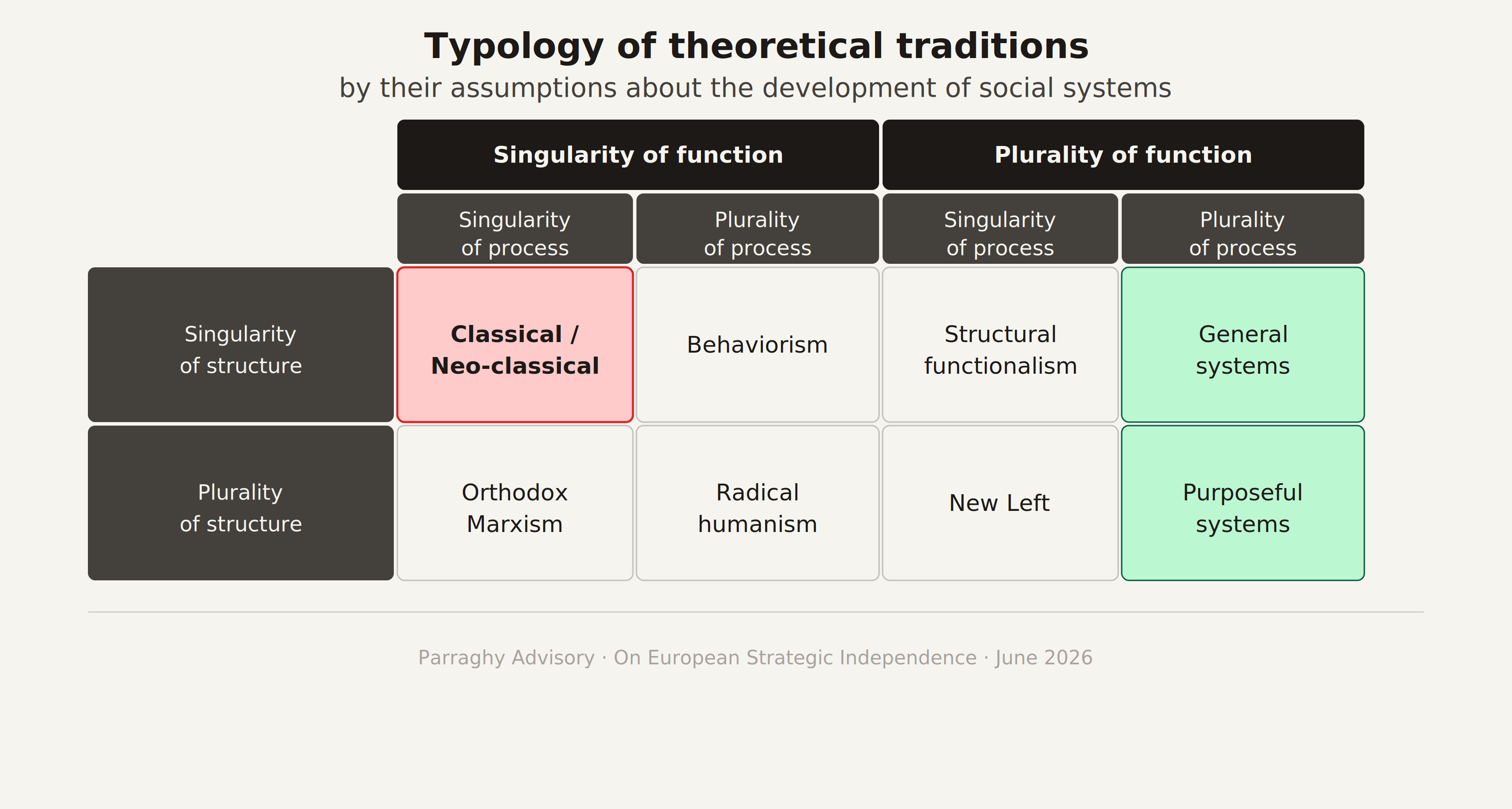
The ECFR's managed interdependence, along with Ostpolitik and Wandel durch Handel before it, treat all three as singular simultaneously. According to the assumptions of the worldview the primary function of a state is to maximize the material welfare of its population. The structure through which states pursue that function is the rational calculation of material interest. And the process by which relationships between states develop follows a fixed linear logic, where trade creates mutual dependency, mutual dependency creates symmetric costs of disruption, and those costs pull political relationships toward stability and eventually alignment over time. Each conclusion the framework produces follows from those three assumptions being held at once, and it is internally consistent on its own terms.
What the framework requires to be true
The question became what conditions must be met for that logic to hold.
The first is symmetry of the dependence. The underlying assumption is that dependencies stabilize relationships when both parties have comparably more to lose from disruption than from applying pressure. Where one party built the dependency deliberately as a strategic asset and the other accumulated it through individually rational market decisions, that condition does not hold. China's leverage over Europe as document in Part IX to Part XI does not create any comparable European leverage over China. The flows are not reciprocal in the way the strategy requires, and the network structure Farrell and Newman describe is precisely what makes them non-reciprocal by design. A dependency that was engineered on one side with the intent to use it as leverage cannot be managed as though it were a symmetric mutual vulnerability on both.
The second is more demanding still. It requires that deepening trade gradually aligns the shared images of two nations and their societies, meaning the unconscious assumptions that the overwhelming majority within each hold to be inherently true about their existence, their legitimacy, their values, and what the right order of things ought to be. The second requirement rests on the assumption that at its core a society is the expression of people trading with each other, building commercial relationships, accumulating shared economic interests, and gradually developing the common ground that holds them together.
If that is how societies form, function and develop, then two nations that deepen their trade with each other will over time become less distinct, their interests, assumptions and values more aligned, until the commercial relationship produces something resembling political and societal convergence. That is the logic Wandel durch Handel and Ostpolitik were built on. The question worth asking before testing it against the evidence is whether it accurately describes how societies and national identities form.
What we know about how social systems form, function, and develop
Societies emerged from dominance hierarchies shaped by evolutionary biology long before any commercial exchange existed. From shared meaning constructed through myth, narrative, ritual, and the accumulated assumptions that hold groups together and tell them what they are and what they owe each other. Economic activity is something organized societies then do with other organized societies. It develops within the social organization that already exists, shaped by the shared image that already holds. This means that economic relationships can reinforce political alignment when the shared images of two societies are already broadly compatible, but they cannot create that alignment where the shared images were formed through entirely different histories, entirely different understandings of legitimacy and survival, and entirely different assumptions about the right order of things.
The evidence of the past decade confirms the direction of that causal link. Russia's shared image, its understanding of its own historical identity, its legitimate sphere of influence, and the right order of European security, was not reshaped by decades of European commercial engagement. It shaped how Russia used that engagement, including as a leverage instrument when the relationship became strategically convenient to weaponize.
China's trajectory follows the same pattern. The pharmaceutical precursor dependencies, the fertilizer input positions, the cotton linter exposure, and the rare earth leverage I traced upstream were not incidental outcomes of competitive markets. They were the deliberate result of an industrial strategy designed to create structural leverage over states whose supply chains China could make dependent on its production decisions. The shared image driving that strategy, China's understanding of its own strategic interests and the instruments appropriate for pursuing them, was not being moved by the commercial engagement.
Wandel durch Handel was not wrong because its architects were naive. It was wrong because it applied a downstream variable, trade, to reshape upstream conditions, the shared images of another nations society, that were never aligned with European ones in the first place and were not moved by the commercial engagement that followed.
Where the argument is bounded
The deeper problem with the strategic interdependence framework is that the framework does not distinguish between the categories of dependency where de-risking is an adequate response and those where it is not. There is a floor below which de-risking is not a strategy but a way of describing a structural vulnerability in more comfortable language. That floor is defined by what is required for a group of people to ensure their survival as a distinct group of people.
A group of people that cannot meet its own energy demand from sources within its control, defend its people and territory from adversaries, care for its wounded or feed its population under conflict conditions, and protect its population from external attempts to shape and subjugate it through information warfare, has no reliable means of ensuring its survival as a distinct group of people with its own identity, values, and the right to determine its own future, regardless of how many diplomatic relationships it maintains.
I documented three domains that sit below that floor. The framework does not give Europe the tools to recognize that distinction, which is why it arrives at de-risking as the answer to a problem de-risking cannot solve. I will examine this in full depth in a standalone article outside this series.
None of this is an argument for either comprehensive decoupling or for autarky. The authors behind the ECFR's paper on strategic interdependence are right that Europe will always be interdependent with a range of powers and that the goal cannot be self-sufficiency across every domain.
It is that not all partners, governments, and nations are equal, and that a strategic framework designed to protect European interests must treat each relationship according to the actual intent of the other party, the nature of the leverage they hold or are building, and whether the dependency in question touches a critical function of the society or not.
Not that all interdependencies are vulnerabilities, and the argument I have been making in the articles Part IX to Part XI is that the specific upstream chemistry that cannot be substituted under conflict conditions and that is currently held by actors whose strategic interests diverge from European ones belongs in the category the ECFR itself concedes warrants reduction rather than management.
What the next part will cover
I address in Part XII-B what my conclusions require in capital, facility, and sequencing terms. I work through each facility type the system requires, size each against European conflict-scenario demand plus the margin that makes the system survivable rather than merely sufficient, and arrive at a combined figure for the reconstruction of the chemical-industrial system.
The pharmaceutical and ammunition demand figures I established in Parts IX and X carry an explicit plus or minus 50 percent uncertainty, reflecting the range of casualty volumes, infection profiles, resistance rates, and firing rates the conflict scenario could produce. The fertilizer demand figures do not carry the same uncertainty, since they are a function of population and agricultural yield requirements rather than conflict variables. The facility counts and cost ranges in Part XII-B are built from the mean of those demand projections. This means, if the actual demand lands either at the lower or upper bound of the demand figures used, then either small or additional facilities of the same size beyond the central estimate would be required.
Citation: Parraghy, D. (2026). On European Strategic Independence, Part XII-A: Three supply chains or one chemical-industrial system?