This is part B of the twelfth article in a series where I examine the structural conditions that would need to change for Europe to function as a genuinely independent strategic actor.
In the previous article I established that the three supply chains documented across Parts IX through XI draw from one chemical-industrial system, and that governing it requires a single cross-domain mandate at European level rather than three separate domain programs.
In this article I examine the theoretical foundations of the frameworks that have shaped European policy since the end of the Second World War, work through what those frameworks argue, what they assume and require to be true about how societies, nations, and states form, function, and develop, test those assumptions against what we know about how they actually do, and conclude where the argument is bounded.
Whether the dependencies should be managed or reduced
Before examining what reducing these dependencies would require and at what cost, I had to question my own assumption, because if my assumptions are wrong, then continuing to write this series of articles would be a complete waste of time.
The case for managing dependencies
The European Council on Foreign Relations published a paper in 2023 arguing that full decoupling from actors like China is not just unrealistic but likely damaging to European interests, and that the right response to dependency is de-risking rather than reducing the underlying relationships. The paper acknowledges that some specific dependencies, including critical raw materials, warrant reduction rather than mere management. Where it draws the line is at decoupling, which it argues would divide the EU internally and push Europe into a new cold war alignment that serves neither its interests nor its values.
The first question their framework has to answer is what de-risking achieves when the dependency does not sit in a bilateral supplier relationship but in the structure of the network that sits upstream of every supplier. Henry Farrell and Abraham Newman, two political scientists writing in 2019, showed how global economic networks tend to centralize around a small number of highly connected nodes through which most of the network's flows must pass, and how states controlling those nodes can use them as chokepoints to cut off specific actors from the network entirely. De-risking supplier relationships does not reduce chokepoint exposure when the chokepoint is upstream of every supplier.
The three supply chains I documented in Part IX to Part XI are not all the same kind of problem. Phosphate, potassium, and borosilicate reserves are geologically concentrated in a handful of other locations. For these geographic constraints, managing the supply relationship is the right frame, and de-risking through diversification and diplomatic frameworks is a genuine response to the dependency.
Does the same logic apply to the bulk chemical production capacity that sits upstream of pharmaceutical, ammunition, and fertilizer manufacturing? Or is it a different kind of problem entirely?
That capacity, the ammonia synthesis, the nitric acid production, the pharmaceutical precursor chemistry, the explosive compound manufacturing, is concentrated where it is concentrated because of decades of rational decisions to offshore production to lower-cost locations, combined in China's case with deliberate industrial strategy designed to create structural leverage. If European pharmaceutical manufacturers, ammunition producers, and fertilizer suppliers each diversify across a range of suppliers in different countries, but all of those suppliers draw their bulk chemical inputs from the same upstream production concentrated in Chinese facilities, then the diversification addresses the visible layer of each supply chain while the structural dependency beneath all three remains intact.
I had to answer the question to which category the dependencies I documented belong to, and to do so, I had to examine what the managed interdependence position requires to be true about how nations and their relationships work.
The frameworks implicit assumptions about how social systems form, function, and develop
The frameworks of managing strategic interdependence, Ostpolitik, and Wandel durch Handel, which is the German policy doctrine that translates roughly as change through trade, treat states primarily as economic actors whose decisions are governed by rational calculations of material interest, and their relationships as stabilized by the mutual costs of disruption that deepening trade creates. This is homo economicus applied to nations rather than individuals.
Claims that shape industry thinking, inform policymaking, or influence decisions with consequences for large numbers of people are not exempt from the scrutiny applied to any serious academic or professional argument. Other disciplines have studied what these frameworks assume to be true, and I stated in an article outside of this series what that means for any interpretation, or in this case theory, I quote:
If an interpretation from one field does not align with findings from other disciplines, across levels of abstraction, then it is likely to be flawed or partial.
From a systems science perspective, theories about how social systems such as societies, nations, and economies develop differ from each other along three dimensions regarding what they assume about the primary function of a society, the structure through which that function operates, and the process by which societies develop and change. A theory can treat each of these three as singular, meaning fixed, primary, and operating the same way in all environments, or as plural, meaning variable, multiple, and shaped by context, interaction, and feedback.
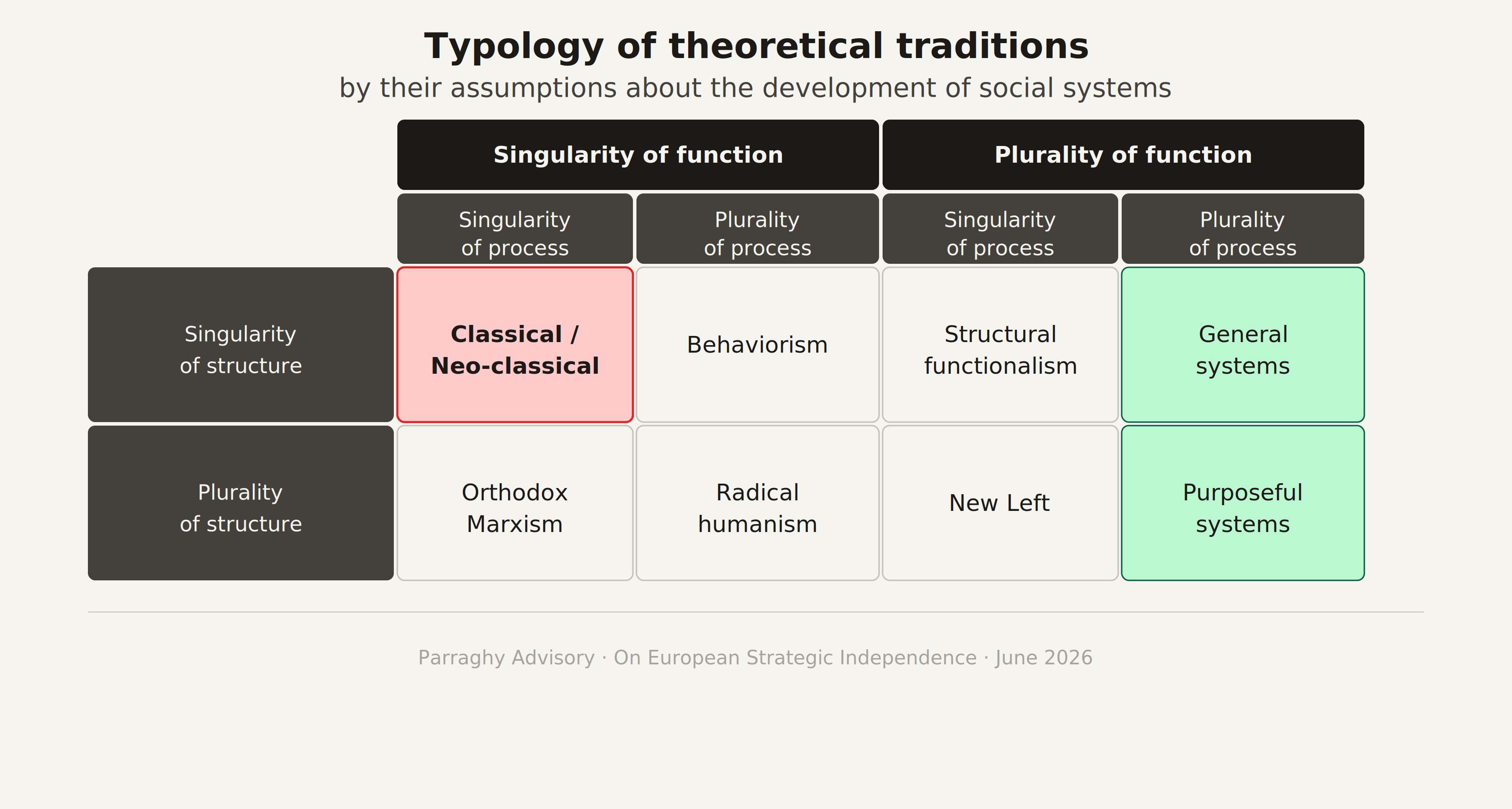
The ECFR's managed interdependence, along with Ostpolitik and Wandel durch Handel before it, treat all three as singular simultaneously. According to the assumptions of the worldview the primary function of a state is to maximize the material welfare of its population. The structure through which states pursue that function is the rational calculation of material interest. And the process by which relationships between states develop follows a fixed linear logic, where trade creates mutual dependency, mutual dependency creates symmetric costs of disruption, and those costs pull political relationships toward stability and eventually alignment over time. Each conclusion the framework produces follows from those three assumptions being held at once, and it is internally consistent on its own terms.
What the framework requires to be true
The question became what conditions must be met for that logic to hold.
The first is symmetry of the dependence. The underlying assumption is that dependencies stabilize relationships when both parties have comparably more to lose from disruption than from applying pressure. Where one party built the dependency deliberately as a strategic asset and the other accumulated it through individually rational market decisions, that condition does not hold. China's leverage over Europe as document in Part IX to Part XI does not create any comparable European leverage over China. The flows are not reciprocal in the way the strategy requires, and the network structure Farrell and Newman describe is precisely what makes them non-reciprocal by design. A dependency that was engineered on one side with the intent to use it as leverage cannot be managed as though it were a symmetric mutual vulnerability on both.
The second is more demanding still. It requires that deepening trade gradually aligns the shared images of two nations and their societies, meaning the unconscious assumptions that the overwhelming majority within each hold to be inherently true about their existence, their legitimacy, their values, and what the right order of things ought to be. The second requirement rests on the assumption that at its core a society is the expression of people trading with each other, building commercial relationships, accumulating shared economic interests, and gradually developing the common ground that holds them together.
If that is how societies form, function and develop, then two nations that deepen their trade with each other will over time become less distinct, their interests, assumptions and values more aligned, until the commercial relationship produces something resembling political and societal convergence. That is the logic Wandel durch Handel and Ostpolitik were built on. The question worth asking before testing it against the evidence is whether it accurately describes how societies and national identities form.
What we know about how social systems form, function, and develop
Societies emerged from dominance hierarchies shaped by evolutionary biology long before any commercial exchange existed. From shared meaning constructed through myth, narrative, ritual, and the accumulated assumptions that hold groups together and tell them what they are and what they owe each other. Economic activity is something organized societies then do with other organized societies. It develops within the social organization that already exists, shaped by the shared image that already holds. This means that economic relationships can reinforce political alignment when the shared images of two societies are already broadly compatible, but they cannot create that alignment where the shared images were formed through entirely different histories, entirely different understandings of legitimacy and survival, and entirely different assumptions about the right order of things.
The evidence of the past decade confirms the direction of that causal link. Russia's shared image, its understanding of its own historical identity, its legitimate sphere of influence, and the right order of European security, was not reshaped by decades of European commercial engagement. It shaped how Russia used that engagement, including as a leverage instrument when the relationship became strategically convenient to weaponize.
China's trajectory follows the same pattern. The pharmaceutical precursor dependencies, the fertilizer input positions, the cotton linter exposure, and the rare earth leverage I traced upstream were not incidental outcomes of competitive markets. They were the deliberate result of an industrial strategy designed to create structural leverage over states whose supply chains China could make dependent on its production decisions. The shared image driving that strategy, China's understanding of its own strategic interests and the instruments appropriate for pursuing them, was not being moved by the commercial engagement.
Wandel durch Handel was not wrong because its architects were naive. It was wrong because it applied a downstream variable, trade, to reshape upstream conditions, the shared images of another nations society, that were never aligned with European ones in the first place and were not moved by the commercial engagement that followed.
Where the argument is bounded
The deeper problem with the strategic interdependence framework is that the framework does not distinguish between the categories of dependency where de-risking is an adequate response and those where it is not. There is a floor below which de-risking is not a strategy but a way of describing a structural vulnerability in more comfortable language. That floor is defined by what is required for a group of people to ensure their survival as a distinct group of people.
A group of people that cannot meet its own energy demand from sources within its control, defend its people and territory from adversaries, care for its wounded or feed its population under conflict conditions, and protect its population from external attempts to shape and subjugate it through information warfare, has no reliable means of ensuring its survival as a distinct group of people with its own identity, values, and the right to determine its own future, regardless of how many diplomatic relationships it maintains.
I documented three domains that sit below that floor. The framework does not give Europe the tools to recognize that distinction, which is why it arrives at de-risking as the answer to a problem de-risking cannot solve. I will examine this in full depth in a standalone article outside this series.
None of this is an argument for either comprehensive decoupling or for autarky. The authors behind the ECFR's paper on strategic interdependence are right that Europe will always be interdependent with a range of powers and that the goal cannot be self-sufficiency across every domain.
It is that not all partners, governments, and nations are equal, and that a strategic framework designed to protect European interests must treat each relationship according to the actual intent of the other party, the nature of the leverage they hold or are building, and whether the dependency in question touches a critical function of the society or not.
Not that all interdependencies are vulnerabilities, and the argument I have been making in the articles Part IX to Part XII-A is that the specific upstream chemistry that cannot be substituted under conflict conditions and that is currently held by actors whose strategic interests diverge from European ones belongs in the category the ECFR itself concedes warrants reduction rather than management.
What the next part will cover
I address in Part XII-C what my conclusions require in capital, facility, and sequencing terms. I work through each facility type the system requires, size each against European conflict-scenario demand plus the margin that makes the system survivable rather than merely sufficient, and arrive at a combined figure for the reconstruction of the chemical-industrial system.
The pharmaceutical and ammunition demand figures I established in Parts IX and X carry an explicit plus or minus 50 percent uncertainty, reflecting the range of casualty volumes, infection profiles, resistance rates, and firing rates the conflict scenario could produce. The fertilizer demand figures do not carry the same uncertainty, since they are a function of population and agricultural yield requirements rather than conflict variables. The facility counts and cost ranges in Part XII-B are built from the mean of those demand projections. This means, if the actual demand lands either at the lower or upper bound of the demand figures used, then either small or additional facilities of the same size beyond the central estimate would be required.
References
- Smeets, M. & van Hees, N. (2023). Strategic interdependence: Europe's new approach in a world of middle powers. European Council on Foreign Relations. https://ecfr.eu/publication/strategic-interdependence-europes-new-approach-in-a-world-of-middle-powers/
- Farrell, H. & Newman, A. (2019). Weaponized Interdependence: How Global Economic Networks Shape State Coercion. International Security. 44(1):42-79. DOI: https://direct.mit.edu/isec/article/44/1/42/12237/Weaponized-Interdependence-How-Global-Economic
- Bahr, E. (1963). Wandel durch Annäherung. Speech delivered at the Evangelische Akademie Tutzing, July 15, 1963.
- Gharajedaghi, J. (2006). Systems Thinking: Managing Chaos and Complexity. A Platform for Designing Business Architecture (2nd ed.). Butterworth-Heinemann.
- Kempin, R. & Meier-Walser, R. (2025). Dead or dormant? German Ostpolitik after Ukraine. European Journal of International Security. Cambridge University Press. DOI: https://resolve.cambridge.org/core/journals/european-journal-of-international-security/article/dead-or-dormant-german-ostpolitik-after-ukraine/4A194E99FFBB80D89FE841EB1EA474C5
- Parraghy, D. (2026). On European Strategic Independence, Part IX: War, and what it takes to keep the wounded alive, https://parraghyadvisory.com/articles/war-and-what-it-takes-to-keep-the-wounded-alive.html
- Parraghy, D. (2026). On European Strategic Independence, Part X: European ammunition sovereignty and the supply chains it requires, https://parraghyadvisory.com/articles/european-ammunition-sovereignty-and-the-supply-chains-it-requires.html
- Parraghy, D. (2026). On European Strategic Independence, Part XI: Feeding Europe independently under conflict conditions, https://parraghyadvisory.com/articles/feeding-europe-independently-under-conflict-conditions.html
- Parraghy, D. (2026). On Complex Systems, Prehistoric and tribal leadership and the early codifications of power, https://danielparraghy.substack.com/p/ocs-3-prehistoric-and-tribal-leadership
Citation: Parraghy, D. (2026). On European Strategic Independence, Part XII-B: Testing the theoretical foundations of the ECFR's strategic interdependence framework, https://parraghyadvisory.com/articles/testing-the-theoretical-foundations-of-the-ecfrs-strategic-interdependence-framework.html